Restoring a Smile After a Severe Facial Injury
A journey of recovery following a chainsaw accident.
At a Glance
The Challenge
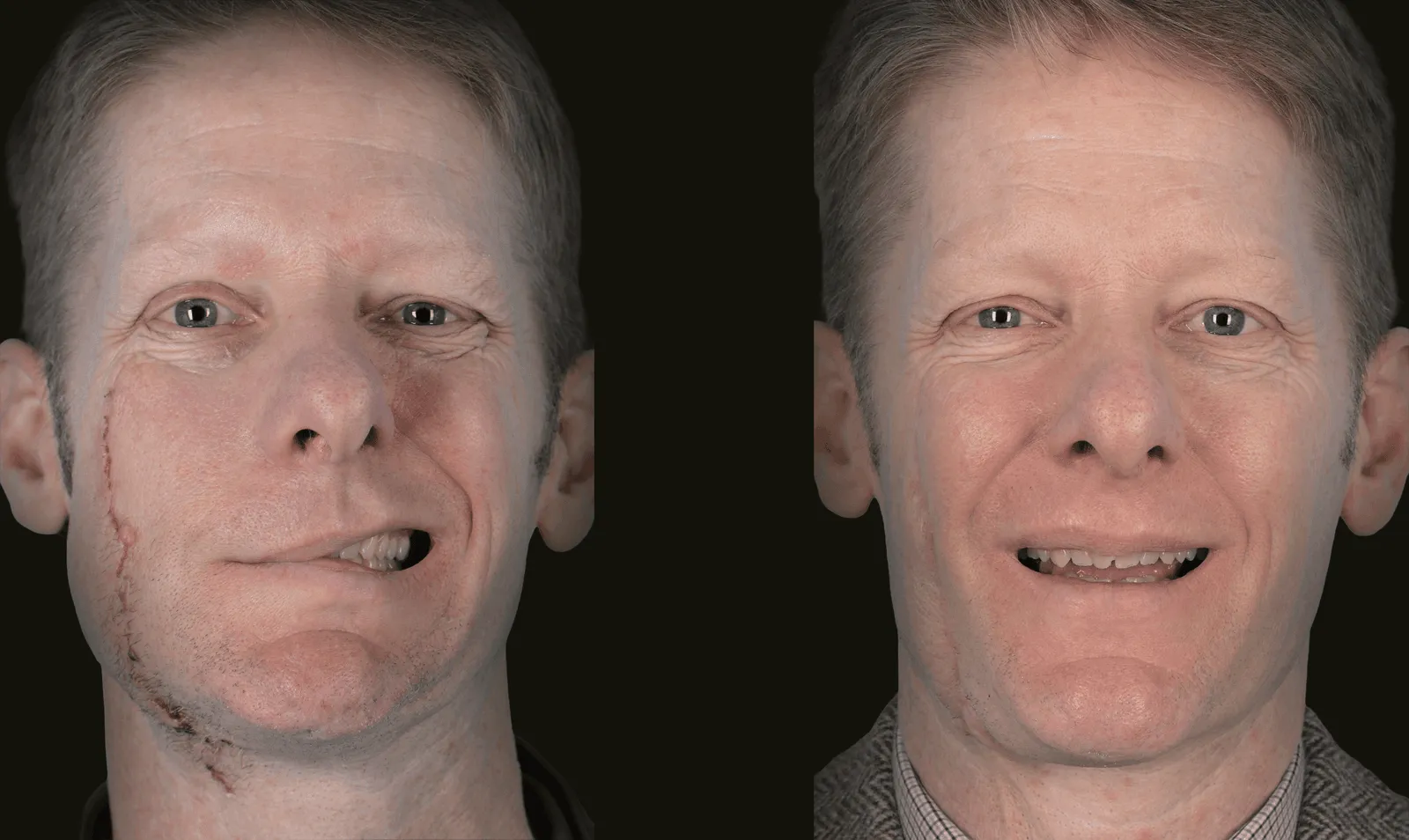
This patient suffered a traumatic chainsaw injury to the face, causing severe soft tissue damage and severing the parotid duct (the tube that carries saliva) and multiple branches of the facial nerve. This resulted in immediate paralysis of the affected muscles of facial expression, making it impossible to smile, along with leakage of saliva through the skin of the cheek.
The Solution
Dr. Jowett performed a complex repair to restore facial form and function. To bridge the gaps in the severed facial nerve branches, multiple small nerve grafts were used to reconnect the brain's signals to the facial muscles. Simultaneously, the damaged salivary duct was carefully reconstructed to restore normal salivary flow to the inside of the mouth.
Technical Insight
Procedure: Facial nerve exploration and repair with interposition nerve graft; parotid duct reconstruction.
Surgical Note: Acute sharp transection injuries offer the best prognosis for primary repair. When a tension-free coaptation is not possible due to tissue loss or retraction, an autologous nerve graft (typically from the great auricular or sural nerve) is harvested to bridge the defect. Precise microsurgical neurorrhaphy is critical for optimal axonal regeneration. Stenting of the parotid duct prevents stenosis and sialocele formation.
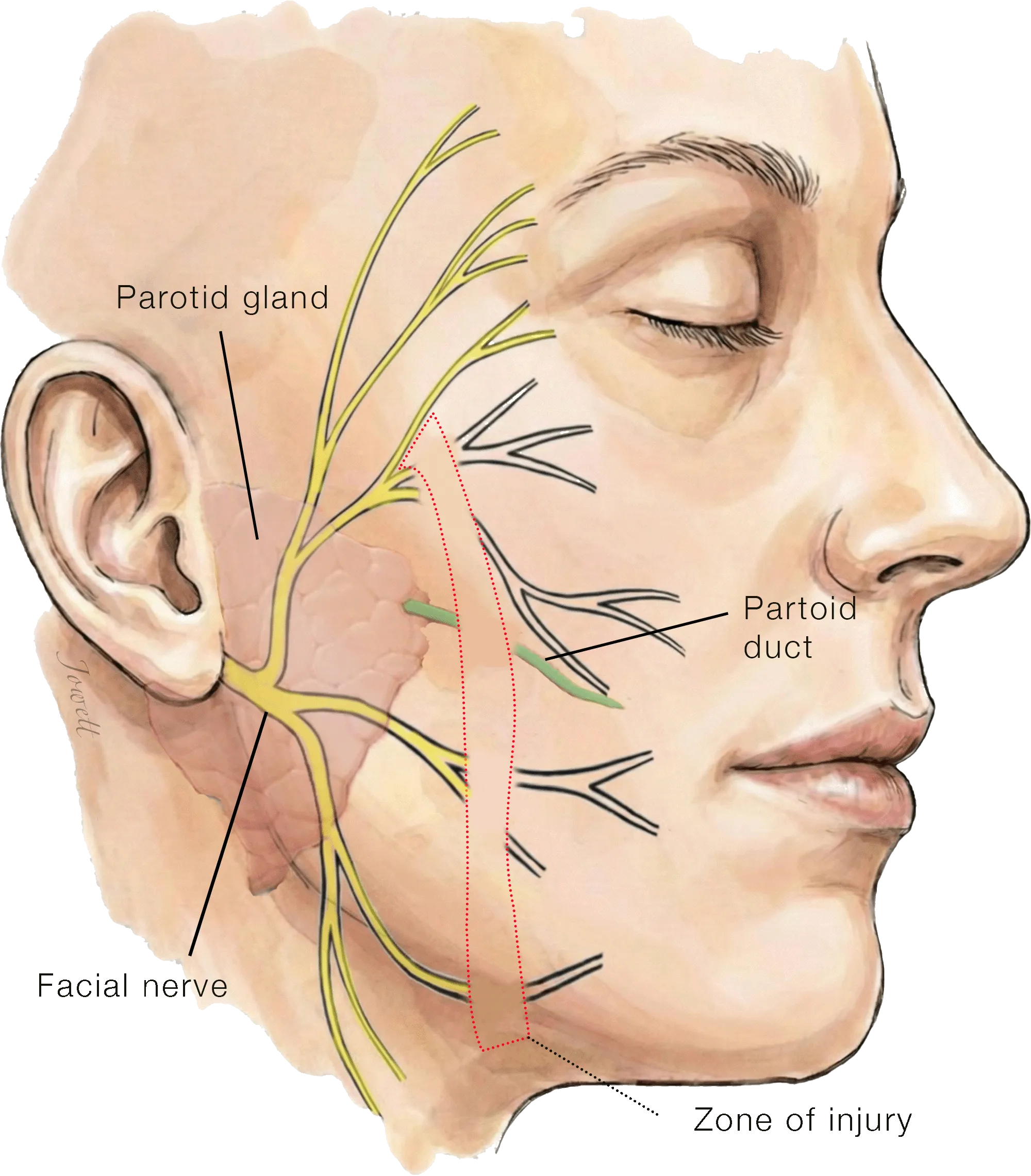
Deep Facial Laceration
Sharp cheek injuries can cut facial nerve branches, causing paralysis of some facial expressions, and sever the parotid duct, leading to saliva leaking through the skin.
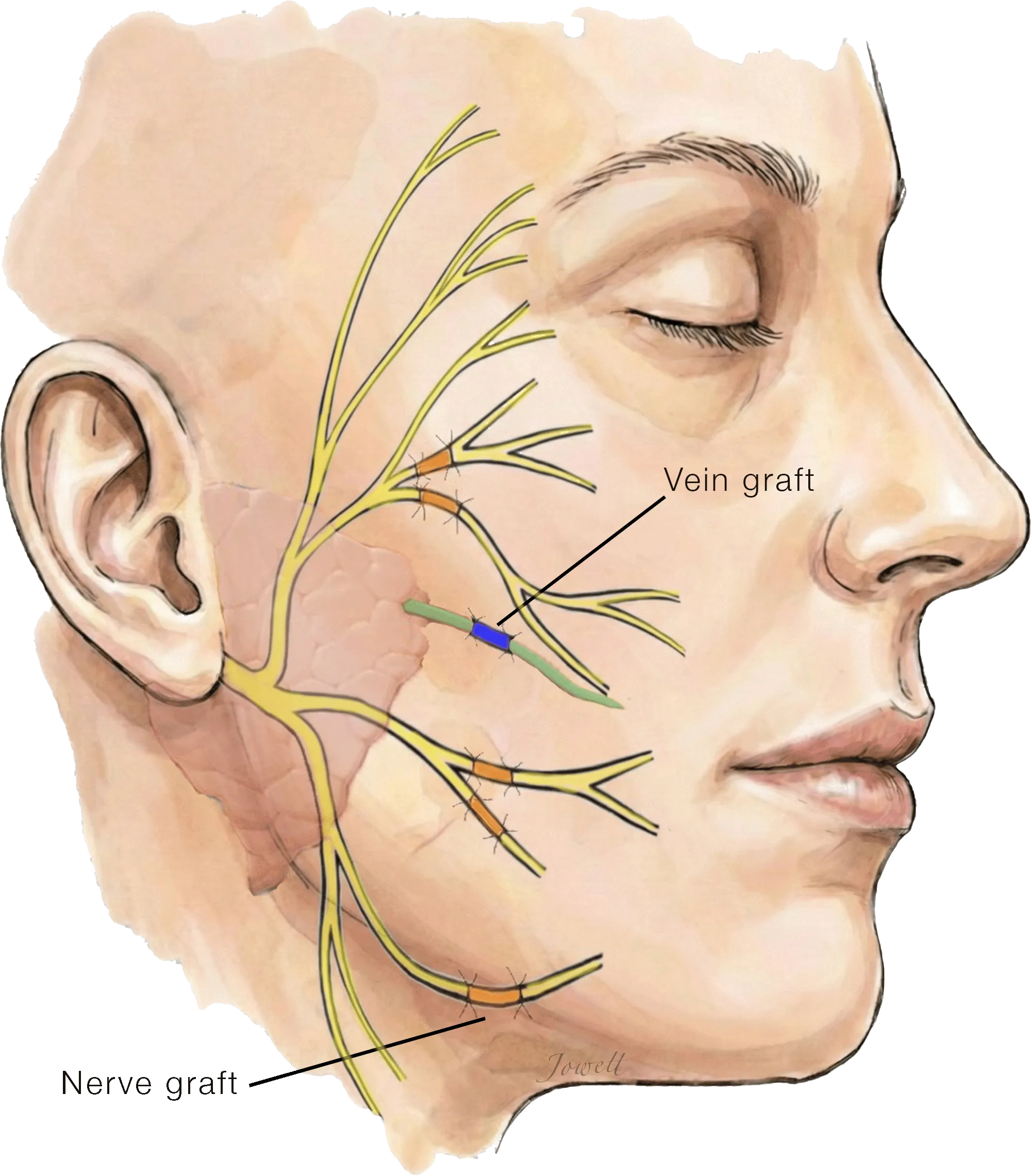
Facial Nerve Distal Branch and Parotid Duct Repair
A nerve supplying sensation to the earlobe ('great auricular nerve') was dissected and cut into multiple segments. The small nerve grafts were then sewn into position using a microscope to bridge the gaps between multiple transected facial nerve branches. A small vein graft was used to bridge the gap in the transected parotid duct.
The Outcome
The video demonstrates the result 9 months after surgery. The patient has regained near normal facial tone and movement with complete resolution of salivary leak.