Selective Neurectomy Surgery(A Durable Option for Synkinesis)
A highly specialized procedure that selectively reduces unwanted motor input to improve tightness, linked movement, comfort, and smile balance in carefully selected patients.
Related case studies
Selective Neurectomy at a Glance
- What it is: A microsurgery that precisely cuts "miswired" nerve branches causing tight, fighting muscles.
- Who it's for: Patients with long-standing synkinesis (from Bell's palsy, trauma, etc.) who are tired of returning for frequent Botox injections.
- The goal: Durable reduction in facial tension and unwanted movement with a freer, more balanced smile; recurrence or residual symptoms remain possible.
What is a Selective Neurectomy?
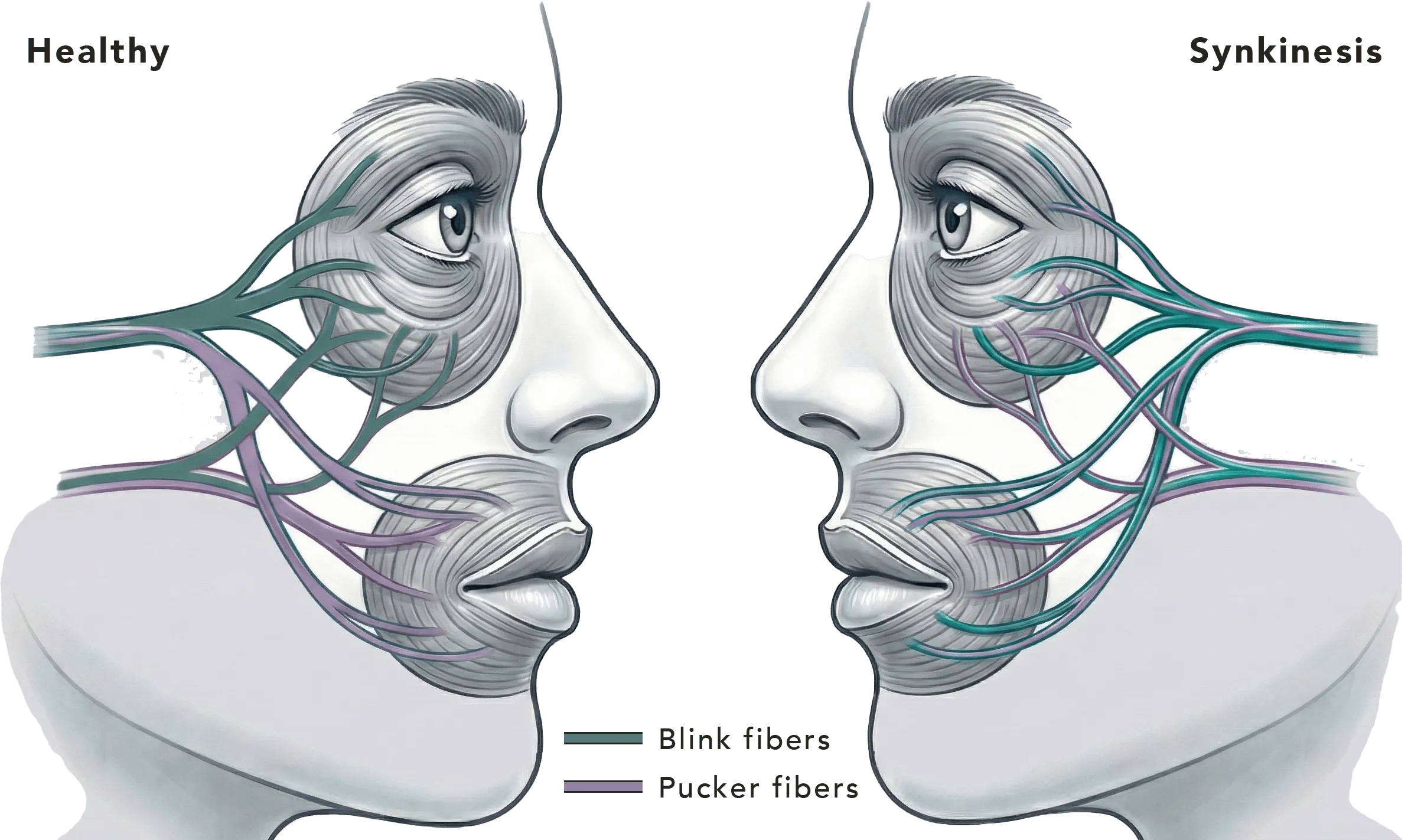
When a facial nerve recovers from an injury (such as Bell's palsy or trauma), the nerve fibers can grow back improperly and connect to the wrong muscles. This "miswiring," known as Synkinesis, causes muscles to fight against each other. The result is chronic facial tightness, pain, an inability to smile fully, and involuntary movements (like the eye squeezing shut when chewing).
While Botox is highly effective at temporarily weakening these miswired muscles, the results wear off every few months. Modified Selective Neurectomy is the surgical, definitive alternative.
During this intricate microsurgery, Dr. Jowett meticulously maps the facial nerve network using electrical stimulation. He then selectively cuts (releases) the specific, microscopic nerve branches that are causing the unwanted tension, such as the branches pulling the mouth downward or the neck bands tightly inward, while carefully preserving the healthy branches necessary for your smile and eye closure.
Conditions Treated with Selective Neurectomy
Selective neurectomy is typically reserved for stable, limiting post-paralysis synkinesis that has improved with well-mapped botulinum toxin but remains burdensome despite expert neuromuscular retraining. It is intended to be more durable than injection alone, not guaranteed permanent.
Chronic Bell's Palsy
Severe, unresolving facial tightness and miswiring years after onset.
Facial Nerve Trauma
Nerve cross-wiring following a severe crush injury or surgical repair.
Acoustic Neuroma
Post-operative synkinesis from tumor resection recovery.
Ramsay Hunt Syndrome
Deep facial aching and restriction following viral damage.
What Selective Neurectomy Can Relieve
- Long-Term Facial Comfort: Reducing selected motor input can ease the aching cramp created by muscles contracting against each other.
- Unleashing the Smile: Weakening selected depressor pathways can reduce downward resistance and allow upward smile muscles to work more effectively.
- Improved Resting Symmetry: Relaxes the hyper-contracted side of the face so it no longer looks "pulled" or tight when you are simply resting.
- Freedom from Injections: Replaces the need to visit the clinic every 3-4 months for therapeutic Botox injections.
How Selective Neurectomy Is Performed
Selective Neurectomy is considered one of the most intricate and delicate procedures in facial plastic surgery. It requires operating through discreet incisions (often hidden in the natural creases of the face and neck, similar to a facelift approach).
Dr. Jowett locates the facial nerve branches under magnification and tests selected branches with a nerve stimulator. A branch that reproduces an unwanted pull may be divided, while branches producing useful movement are identified for preservation. The intent is to reduce competing movement while retaining smile and eye function; incomplete improvement, new weakness, asymmetry, nerve regrowth, and revision remain possible.
What the Evidence Shows
Selective neurectomy is for synkinesis that still feels trapped after therapy and Botox.
- The operation maps and quiets the branches that close the eye or band the neck when you try to smile.
- It is not a first-line treatment. Retraining and chemodenervation come first.
- The goal is a freer smile and less tightness, not a frozen face.
- Candidacy generally expects stable, non-worsening facial function and a completed course of retraining. How you responded to previous botulinum toxin helps predict which muscles and branches to target.
- Neurectomy is often combined with selective myectomy - weakening or removing specific overactive muscles such as the depressor anguli oris, which pulls the mouth corner down, and the platysma, which bands the neck. Comparative work reports better smile measurements and less neck tightness with the combination than with myectomy alone.
- Most patients need considerably less botulinum toxin afterward and some need none, though injections around the eye are often continued because surgery treats eye-region synkinesis less well.
- The specific risks worth understanding are oral incompetence - trouble keeping food or liquid in the mouth, drooling, or difficulty chewing - and overweakening of the smile or lower lip if too many branches are divided. Many of these deficits are temporary or can be balanced with botulinum toxin or filler, but some persist.
- Evidence quality is moderate. Findings come mainly from single-surgeon case series and retrospective comparisons rather than randomized trials, so techniques and results vary between surgeons.
Why Choose Revitalis for Selective Neurectomy?
Dr. Nate Jowett's clinical and peer-reviewed work includes facial reanimation and treatment for synkinesis. Modified selective neurectomy is one option he evaluates for selected patients.
Because the procedure intentionally interrupts selected motor branches, anatomy, mapping, and judgment are central. Dr. Jowett uses examination, therapy response, and carefully targeted Botox as a reversible preview of which patterns may respond to surgery. A positive injection response supports selection but cannot promise an identical surgical result; nerve regrowth, changing recruitment, revision, and occasional continued injections are possible.
Common questions
Questions Patients Ask
Who is a candidate for selective neurectomy?
Candidates have stable post-paralysis synkinesis with a reproducible overactive pattern that remains limiting despite expert retraining and well-mapped injections. The symptom should also improve when the proposed target is temporarily weakened.
Is selective neurectomy permanent?
It is intended as a durable operation, but nerve regrowth and changing muscle recruitment can reduce or alter the effect. Some patients continue occasional botulinum toxin or need revision.
What is the difference between neurectomy and myectomy?
Neurectomy reduces motor input by dividing selected nerve branches. Myectomy removes or releases part of an overactive muscle. They can be used separately or together depending on the movement pattern.
Will I still need Botox after selective neurectomy?
Often much less, and some patients need none. Many still use smaller, less frequent injections - particularly around the eye, where surgery treats synkinesis less well - or short-term touch-ups during recovery. The realistic goal is fewer injections rather than none forever.
What is oral incompetence, and how likely is it?
Oral incompetence means difficulty keeping food or liquid in the mouth, drooling, or trouble chewing, and it is the specific risk that matters most with this operation. It is often temporary but can persist, and it becomes more likely when more nerve branches are divided. Many temporary deficits improve on their own or can be balanced with botulinum toxin or filler.
How strong is the evidence for this surgery?
Moderate. Reported benefits - better smile measurements, less neck and facial tightness, less need for botulinum toxin - come mainly from single-surgeon case series and retrospective comparisons rather than randomized trials. Techniques and results vary between surgeons, which is why the discussion is framed as improvement rather than a promised outcome.
Do I still need facial therapy after the operation?
Yes. International consensus places facial neuromuscular retraining first in the treatment sequence, and retraining before and after surgery supports the best result. Surgery changes the balance of pull; therapy teaches you to use the new balance.
Answers are general and individualized at consultation.
Medical References & Evidence-Based Guidelines
- Effect of Weakening of Ipsilateral Depressor Anguli Oris on Smile Symmetry in Postparalysis Facial Palsy. Jowett N, Malka R, Hadlock TA. JAMA Facial Plast Surg. 2017 Jan 01; 19(1):29-33. PMID: 27658020.
- Weighting of Facial Grading Variables to Disfigurement in Facial Palsy. Banks CA, Jowett N, Hadlock CR, Hadlock TA. JAMA Facial Plast Surg. 2016 Jul 01; 18(4):292-8. PMID: 27124886.
- A General Approach to Facial Palsy. Jowett N. A General Approach to Facial Palsy. Otolaryngol Clin North Am. 2018 Dec; 51(6):1019-1031. PMID: 30119926.
- Pathogenesis, Diagnosis and Therapy of Facial Synkinesis: A Systematic Review and Clinical Practice Recommendations. Guntinas-Lichius O, Prengel J, Cohen O, et al. Front Neurol. 2022;13:1019554. PMID: 36438936.
- Selective Myectomies Alone versus Selective Myectomies Combined with Neurectomies in Postparetic Synkinesis: Comparing Outcomes. Sanchez CV, Gault NA, Gopalan TA, et al. Plast Reconstr Surg. 2024;154(4):859-869. PMID: 38315693.
- Selective neurectomy for nonflaccid facial palsy. Ovaitt AK, Chweya CM, Flynn J. Curr Opin Otolaryngol Head Neck Surg. 2023;31(4):244-247. PMID: 37144494.
- Modified Selective Neurectomy for the Treatment of Post-Facial Paralysis Synkinesis. Azizzadeh B, Irvine LE, Diels J, et al. Plast Reconstr Surg. 2019;143(5):1483-1496. PMID: 30807497.