Nerve Transfer Surgery(Rewiring the Face for Movement)
Highly specialized microsurgical procedures that borrow healthy nerve signals from elsewhere in the body to reawaken paralyzed facial muscles.
Related case studies
Nerve Transfer Surgery at a Glance
- What it is: A pairing of donor nerves: the hypoglossal nerve for global facial tone and symmetry, and a targeted masseteric transfer for a volitional, bite-driven smile.
- Who it's for: Patients with severe facial paralysis whose native facial muscles remain receptive to reinnervation; candidacy is not determined by a single 18- or 24-month deadline.
- The goal: Improved resting tone plus intentional smile movement, initially activated by engaging the masseter. Strength, symmetry, and automaticity vary.
What is a Nerve Transfer?
When a facial nerve is severed or irreversibly damaged, the facial muscles lose their signal and stop working. However, for the first 1.5 to 2 years after the injury, those native facial muscles are still alive and capable of contracting if they are provided with a new electrical source. Nerve transfer surgery involves taking a healthy nerve from a nearby area and connecting it to the injured facial nerve.
As the new nerve fibers grow across the surgical connection, they "rewire" into the native facial muscles over several months. Dr. Jowett often assigns each donor a distinct job rather than asking one nerve to do everything:
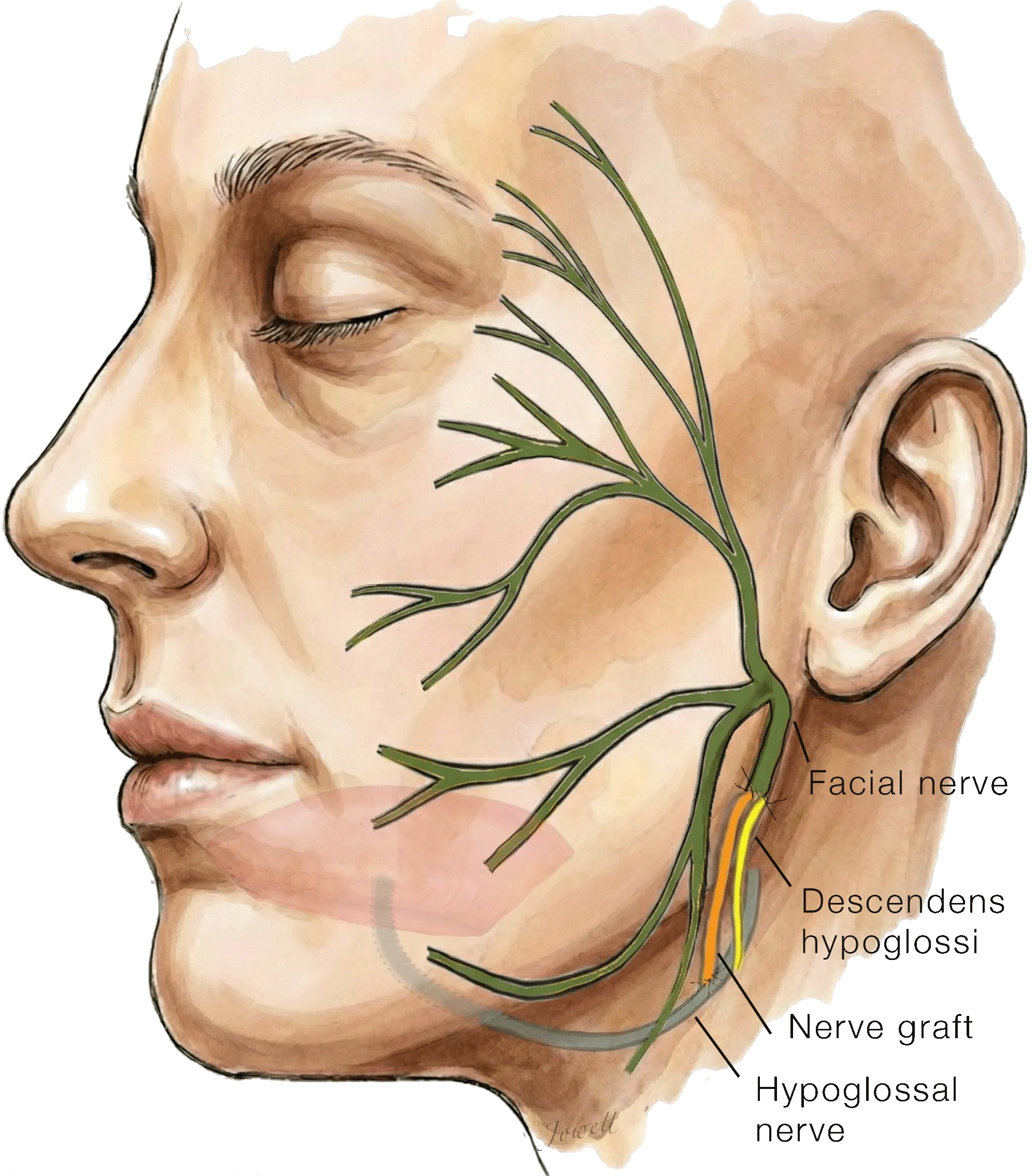
- Hypoglossal nerve (global tone and symmetry): A jump graft from a partially divided tongue nerve supplies the facial-nerve trunk or its main divisions. The main goal is improved resting tone rather than a powerful smile.
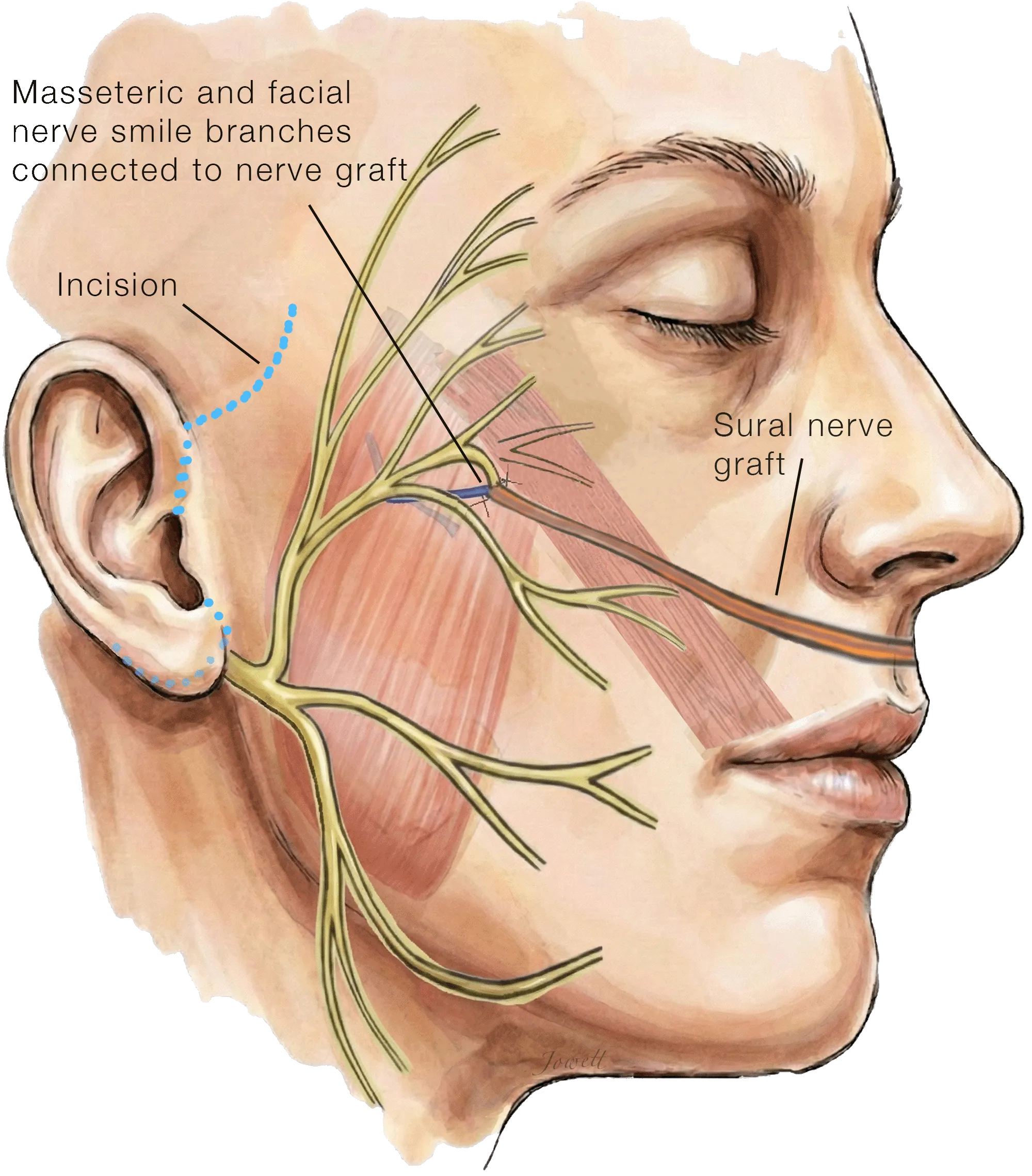
- Targeted masseteric transfer (volitional, bite-driven smile): A chewing-nerve branch is joined only to selected smile branches. The job is a strong, intentional commissure excursion you fire by biting.
- Cross-face nerve graft (optional timing): A cable from the healthy facial nerve can add movement that fires when you feel happy. It is slower and weaker, and it does not replace the tone-plus-smile pairing above.
Conditions Treated with Nerve Transfers
Nerve transfers are highly time-sensitive. They are typically performed on patients whose paralysis occurred less than 24 months ago, before the native facial muscles atrophy completely.
What Nerve Transfer Surgery Can Restore
- Global Tone and Symmetry: A hypoglossal jump graft can improve background tone and support the cheek, lip, and lower face at rest.
- Volitional, Bite-Driven Smile: A targeted masseteric transfer lets you lift the corner of the mouth on command by biting, using the native smile muscles rather than a transplant.
- Improved Oral Competence: Reinnervating cheek and lip muscles may improve oral competence, drooling, articulation, and control while eating.
- Surgical Efficiency: Because it uses the patient's existing facial muscles, nerve transfers are generally less invasive than free muscle transplants.
How Nerve Transfer Surgery Is Performed
The usual plan is a pairing, not a single donor. The hypoglossal nerve is asked to hold the face. The masseteric nerve is asked to smile. Using high-powered magnification and suture thinner than a human hair, Dr. Jowett joins each donor to the facial-nerve territory that matches that job.
Hypoglossal for global tone and symmetry. May's 12-7 jump graft joins an interposition graft to a partially cut hypoglossal nerve instead of sacrificing the whole tongue nerve. In patients followed two years, every face recovered tone and symmetry, and none had significant mass movement. Tongue atrophy was uncommon (three of 23 sides) versus expected hemitongue paralysis after a classic complete crossover. The graft is not chosen for a powerful smile: contractions are weaker and slower than a complete twelfth-to-seventh hook-up, and results are best within about a year of injury. Its job is a face that sits symmetrically at rest.
Targeted masseteric transfer for a volitional, bite-driven smile. A descending masseteric branch is joined only to selected buccal and zygomatic smile branches, not to the whole facial-nerve tree. Klebuc's series showed oral competence and a smile vector comparable to the other side, with motion usually back by about six months and little donor-site cost. You fire that smile by biting. Some patients later smile without a conscious clench — four of ten by 19 months in that series — but that is still a voluntary smile, not a laugh-driven one.
When native smile muscle is gone, a transfer to the old facial nerve is not enough. A free muscle flap can instead be powered by a masseteric-supercharged cross-facial nerve graft — that technique lives on the smile reanimation page.
What the Evidence Shows
The pairing is the point: hypoglossal for how the face sits, masseteric for how it smiles.
- Hypoglossal jump graft (May): global tone and symmetry, without sacrificing the whole tongue nerve. Tongue deficit was 3 of 23 sides. It is weaker and slower than a complete twelfth-to-seventh crossover and is not the smile engine.
- Targeted masseteric transfer (Klebuc): volitional, bite-driven smile to selected smile branches. Motion around six months, about 1.2 cm of commissure excursion. An effortless (no-bite) smile appeared in 4 of 10 by 19 months — still voluntary, not a laugh.
- A cross-face graft can add emotional timing. It does not replace the tone-plus-smile pairing.
- After the muscle window closes, a transfer to the old facial nerve is not enough. A new muscle has to come with the nerve.
- Needle electromyography of the facial muscles is most informative between roughly two weeks and three months after onset. It helps confirm that muscle is denervated but still salvageable, and identifies patients already recovering on their own who do not need surgery.
- Meta-analysis comparing the two workhorse donors matches the pairing logic above: hypoglossal transfer is associated with better resting symmetry, while masseteric transfer is associated with higher composite smile scores and earlier first movement.
- Donor-site cost is not the same across techniques. Complete hypoglossal transfer historically carried meaningful rates of tongue wasting and speech or swallowing difficulty; partial, side-to-end, and jump-graft techniques markedly reduce that risk.
- First movement usually appears around three to six months and continues to develop over one to two years. Quality of facial retraining predicts better volitional control, while older age and a longer delay before surgery predict less.
- Reported adverse effects are generally uncommon in pooled data, but synkinesis, incomplete or asymmetric movement, and the need for revision or static suspension remain possible.
Why Choose Revitalis for Nerve Transfer Surgery?
Dr. Nate Jowett has performed hundreds of complex nerve transfers and has authored foundational literature on their outcomes and reliability.
Nerve transfers are not applied as a generic formula. Dr. Jowett uses the examination and, when indicated, electromyography (EMG) to evaluate remaining nerve and muscle function. Donor strength, spontaneity, denervation time, anatomy, donor-site tradeoffs, rehabilitation, and patient goals guide whether one transfer, combined transfers, or another reconstruction is appropriate. Functional and aesthetic outcomes vary.
Common questions
Questions Patients Ask
Which facial nerve transfer is best?
There is no universal best donor. The choice depends on denervation time, desired movement, available facial branches, tongue and chewing function, age, cancer treatment, and whether strength, tone, or spontaneity is the leading goal.
Will I need to bite to smile after masseteric nerve transfer?
Patients initially activate the smile by engaging the masseter. With practice, some develop increasing automaticity or smile without a deliberate bite, but fully spontaneous emotional movement is not guaranteed.
What if my facial muscles are no longer viable?
A nerve transfer alone cannot move muscle that has undergone irreversible denervation atrophy. Free functional muscle transfer, often using gracilis, can provide a new motor unit for smile reanimation.
Why do I need an EMG before nerve transfer surgery?
Needle electromyography of the facial muscles shows whether the muscles are denervated but still salvageable, and whether you are already recovering on your own and may not need surgery at all. It is most informative between roughly two weeks and three months after onset, which is one reason early referral matters.
Which is better for me, a hypoglossal or a masseteric transfer?
They do different jobs, and the answer depends on what you want most. Meta-analysis has associated hypoglossal transfer with better symmetry at rest and masseteric transfer with higher composite smile scores and earlier first movement. Many plans use both, assigning tone to one donor and the smile to the other.
Will a hypoglossal transfer affect my tongue, speech, or swallowing?
Complete hypoglossal transfer historically carried meaningful rates of tongue wasting and speech or swallowing difficulty. Partial, side-to-end, and jump-graft techniques - which take only part of the nerve - markedly reduce that risk, and are the reason the modern operation is described as a jump graft rather than a full crossover.
What makes a nerve transfer more or less likely to work well?
Earlier reinnervation, before irreversible muscle and motor-endplate wasting, gives better results. Quality of facial retraining afterward predicts better voluntary control, while older age and a longer delay before surgery predict less. Synkinesis, incomplete or asymmetric movement, and the need for revision or static support remain possible in any case.
Answers are general and individualized at consultation.
Medical References & Evidence-Based Guidelines
- Donor Nerve Selection in Facial Reanimation Surgery. Klebuc M, Shenaq SM. Semin Plast Surg. 2004;18(1):53-60. PMID: 20574471.
- Facial Reanimation Using the Masseter-to-Facial Nerve Transfer. Klebuc MJA. Plast Reconstr Surg. 2011;127(5):1909-1915. PMID: 21532419.
- Hypoglossal-Facial Nerve Interpositional-Jump Graft for Facial Reanimation without Tongue Atrophy. May M, Sobol SM, Mester SJ. Otolaryngol Head Neck Surg. 1991;104(6):818-825. PMID: 1908974.
- The Evolving Role of the Masseter-to-Facial (V-VII) Nerve Transfer for Rehabilitation of the Paralyzed Face. Klebuc M. Ann Chir Plast Esthet. 2015;60(5):436-441. PMID: 26364136.
- Five-Year Experience with Fifth-to-Seventh Nerve Transfer for Smile. Banks CA, Jowett N, Iacolucci C, Heiser A, Hadlock TA. Plast Reconstr Surg. 2019 May; 143(5):1060e-1071e. PMID: 31033832.
- A Rapid Protocol for Intraoperative Assessment of Peripheral Nerve Myelinated Axon Count and Its Application to Cross-Facial Nerve Grafting. Wang W, Kang S, Coto Hernández I, Jowett N. Plast Reconstr Surg. 2019 Mar; 143(3):771-778. PMID: 30601328.
- Cross-Face Nerve Grafting Versus Masseteric-to-Facial Nerve Transposition for Reanimation of Incomplete Facial Paralysis: A Comparative Study Using the FACIAL CLIMA Evaluating System. Hontanilla B, Marre D, Cabello Á. Plast Reconstr Surg. 2018;142(2):179e-191e. PMID: 30045184.
- A General Approach to Facial Palsy. Jowett N. A General Approach to Facial Palsy. Otolaryngol Clin North Am. 2018 Dec; 51(6):1019-1031. PMID: 30119926.
- Neurotization Preferences in Smile Reanimation: A Discrete Choice Experiment. Dusseldorp JR, Naunheim MR, Quatela O, Fortier E, Hadlock TA, Jowett N. Plast Reconstr Surg. 2021 Sep 01; 148(3):407e-415e. PMID: 34432695.
- Hypoglossal and Masseteric Nerve Transfer for Facial Reanimation: A Systematic Review and Meta-Analysis. Urban MJ, Eggerstedt M, Varelas E, et al. Facial Plast Surg Aesthet Med. 2022;24(1):10-17. PMID: 33635144.
- Comparison of hypoglossal nerve transfer and hypoglossal jump nerve graft techniques for facial reanimation: A systematic review. Chowdhury R, Morel SBA, ElAbd R, et al. J Plast Reconstr Aesthet Surg. 2025;110:156-183. PMID: 41046626.
- Nerve transfers for facial palsy: grading of volitional control after using the hypoglossal and masseter nerves. Socolovsky M, Martins RS, Miedema S, et al. Neurosurg Focus. 2025;58(4):E3. PMID: 40168760.
- Functional Outcome of Dual Reinnervation with Cross-Facial Nerve Graft and Masseteric Nerve Transfer for Facial Paralysis. Kollar B, Weiss JBW, Kiefer J, et al. Plast Reconstr Surg. 2024;153(6):1178e-1190e. PMID: 37384874.
- Combination of Cross-Face Nerve Grafting and Masseteric Nerve Transfer in the Treatment of Incomplete Facial Paralysis: A Contemporary Systematic Review. Roman Padilla JC, Ortiz Peces L, Chacón Ferrer G, et al. J Craniofac Surg. 2026;37(7-8):1910-1914. PMID: 41665238.