Traumatic Facial Nerve Injury Repair
Expert microsurgical repair and facial reanimation when the unexpected happens.
Related case studies
How Do Facial Nerve Injuries Occur?
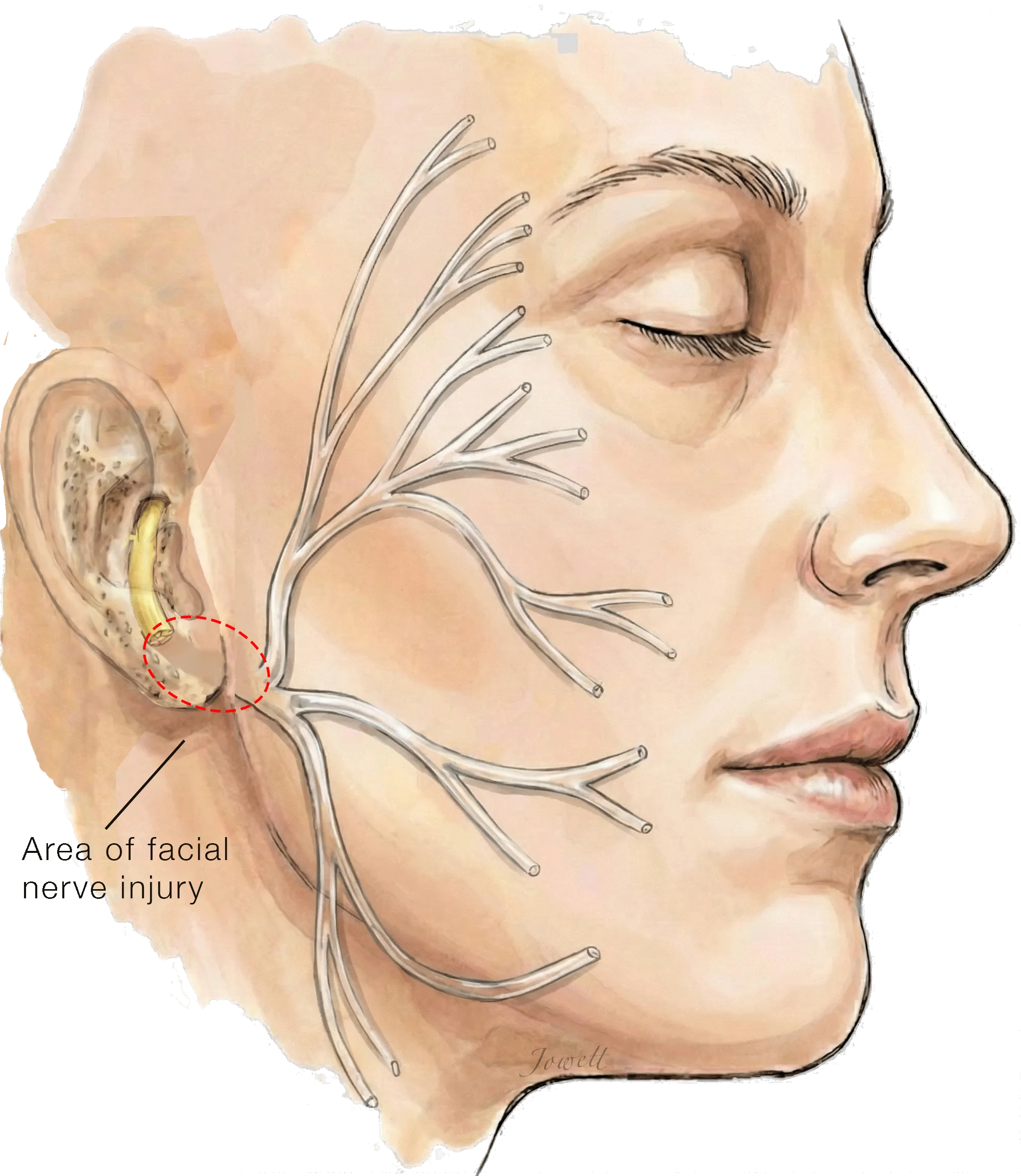
The facial nerve (the 7th cranial nerve) exits the skull just below the ear and branches out across the face like the fingers of a hand. Because these branches lie very close to the surface of the skin, especially in the cheeks, jawline, and near the ears, they are vulnerable to injury. We classify these injuries into two main categories:
Iatrogenic (Surgical) Injuries
Even in the hands of skilled surgeons, the facial nerve can be stretched, bruised, or accidentally severed during complex operations in the head and neck. Common procedures that carry this risk include:
- Parotid Gland Surgery: Removing tumors from the salivary gland, which the facial nerve runs directly through.
- Skull Base Tumor Surgery: Removing tumors near the facial nerve, including vestibular schwannomas (also called acoustic neuromas).
- Cosmetic Surgery: Facelifts, neck lifts, brow lifts, and facial implant procedures.
- Mastoid and Ear Surgery: Procedures addressing chronic ear infections or tumors.
- Temporomandibular Joint (TMJ) or Jaw Surgery.
Traumatic Injuries
These are the result of sudden accidents.
- Blunt Force Trauma: Temporal bone fractures (skull fractures) from falls or vehicle accidents that crush the nerve inside its bony canal.
- Penetrating Trauma: Deep facial lacerations from glass, sharp objects, or animal bites that sever the nerve branches directly.
The Window for Repair: Why Time is Critical
If you have suffered a sharp injury (such as a deep laceration or a known surgical cut to the nerve), immediate intervention is crucial. When a nerve is severed, the ideal time to reconnect it is within the first 72 hours. During this window, the nerve endings can still be stimulated electrically, allowing the surgeon to accurately identify and reconnect the precise branches before they degenerate.
If the injury is older, reconstruction may still be possible. Native muscle receptivity declines with prolonged denervation, but there is no universal 12- or 24-month cutoff; the level and severity of injury, partial innervation, age, muscle condition, and testing all matter. When native smile muscles are no longer viable, free functional muscle transfer and static procedures remain options. Earlier specialist assessment preserves the widest range of choices.
Facial Nerve Injury Symptoms
The symptoms of a facial nerve injury depend entirely on which specific branch of the nerve was damaged, and whether the nerve was bruised (which may heal) or completely severed.
Immediate Flaccid Paralysis
Occurring right after the trauma or surgery, the affected side of the face loses muscle tone. You may experience a drooping eyebrow, a flattened cheek, and difficulty keeping liquids in your mouth while drinking.
Eye Closure Deficits (Lagophthalmos)
If the branch controlling your eyelid is injured, you will lose the ability to blink or fully close your eye. This leaves the cornea exposed, leading to severe pain, chronic dry eye, and a high risk of permanent vision damage.
Synkinesis (Miswiring)
If the nerve was crushed but not cut, it will try to heal over several months. Sometimes, the nerve fibers grow back to the wrong muscles. This causes "synkinesis": unwanted, simultaneous muscle movements, such as your eye squeezing shut when you try to smile, accompanied by facial tightness and pain.
Facial Nerve Injury Surgery Options
Treatment is highly individualized. Based on extensive clinical research and advanced microsurgical techniques, Dr. Jowett offers a spectrum of reconstructive options tailored to the exact timeline and nature of your injury.
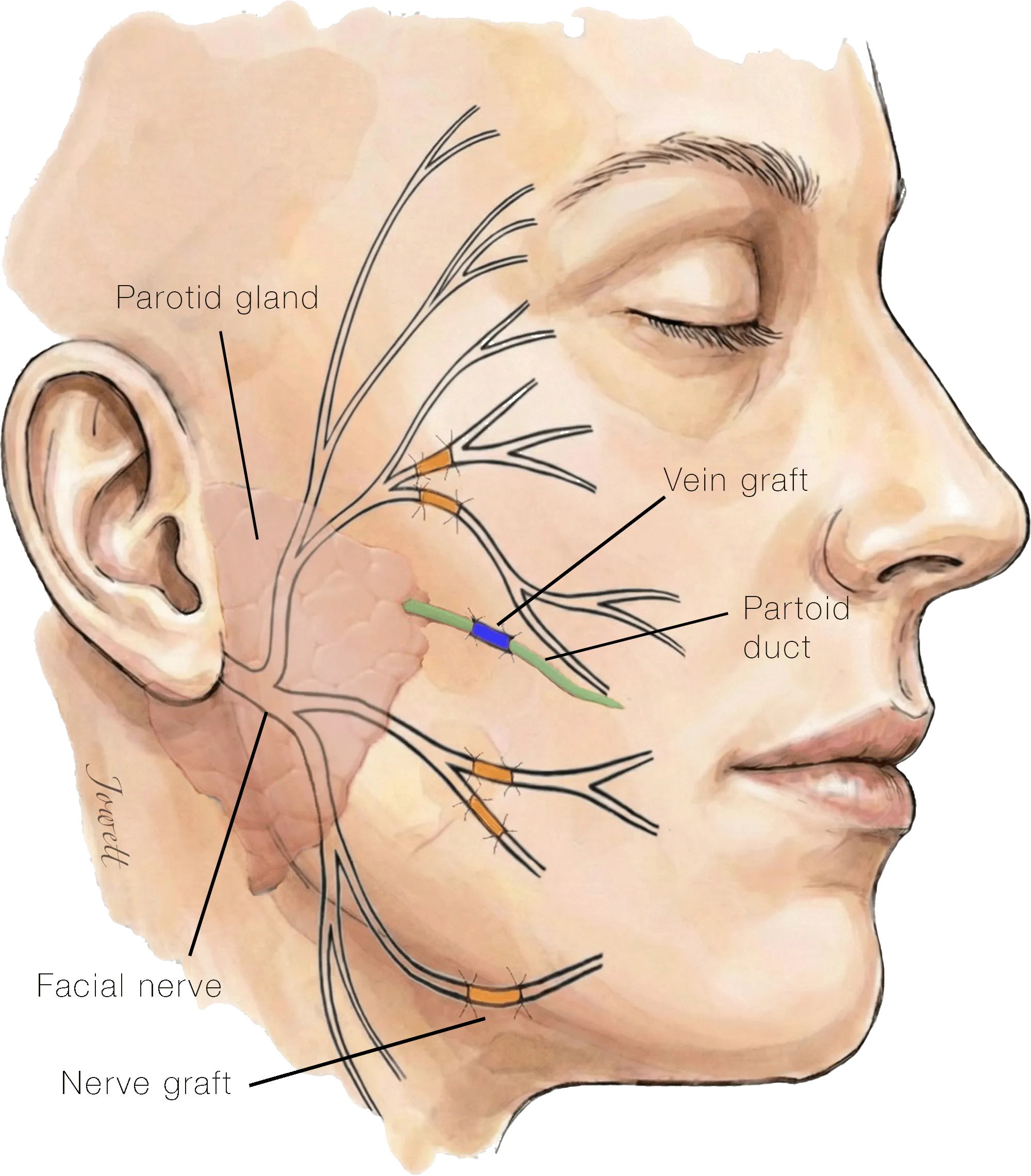
For recent, sharp injuries (like a facial laceration), the best outcome is achieved by finding the cut ends of the facial nerve and sewing them back together under a high-powered microscope. This provides the most natural chance for recovery.
Facial Nerve Injury FAQs
What the Evidence Shows
Timing decides what a cut or crushed facial nerve can still do.
- A known cut outside the skull is explored and repaired, ideally within 72 hours, before the ends retract and scar.
- After a temporal-bone fracture, incomplete or delayed weakness is usually watched. Immediate complete palsy with severe degeneration may need decompression.
- High-dose steroids are started early for fracture-related palsy while the workup proceeds.
- After about 18 months without viable muscle, smile reconstruction shifts to a new muscle rather than a late nerve repair.
- High-resolution CT of the temporal bone maps the fracture and shows where along its bony canal the nerve is injured. Any surgical plan is built from that picture together with hearing status.
- Electrical testing has windows. Electroneurography is informative roughly three to fourteen days after onset, and needle EMG from about two weeks to three months. Neither is used when the paralysis is incomplete.
- Decompression is offered to a narrow group and is not settled science. Some series report favorable results with timely surgery while a controlled comparison found no clear advantage over conservative care, and the operation carries hearing, balance, and spinal-fluid-leak risks.
- Nerve transfers differ in what they give back. A masseteric transfer tends to produce a strong, relatively fast-recovering smile, a hypoglossal transfer favors resting tone and symmetry, and a cross-face graft may allow a more spontaneous smile.
- Recovery after a nerve repair is slow, often many months to more than a year as fibers regrow. Facial retraining with a specialized therapist supports coordination and helps manage synkinesis once movement returns.
Why Choose Revitalis for Facial Nerve Injury?
Dr. Nate Jowett is a facial nerve surgeon whose clinical and peer-reviewed work includes facial reanimation. His fellowship training and background span facial plastic surgery, engineering, and reconstructive microsurgery.
Whether you are days into a diagnosis or have lived with incomplete recovery for years, Dr. Jowett offers the full spectrum of care, from medical management to cutting-edge surgical reconstruction, to help you regain your smile and confidence.
Common questions
Questions Patients Ask
Does a temporal-bone fracture always need facial nerve decompression?
No. Many delayed or incomplete palsies recover with observation and medical care. Decompression is reserved for selected severe injuries based on onset, imaging, electrophysiology, overall trauma, and specialist judgment.
When should a cut facial nerve be repaired?
Known transections should be assessed promptly. When the ends can be identified, early tension-free direct repair or grafting generally avoids prolonged denervation and progressive scarring.
What if the injury happened years ago?
Reanimation can still be possible. If native facial muscles no longer respond, free functional muscle transfer and static procedures can restore smile movement, support, eye protection, and symmetry according to individual goals.
When is electrical nerve testing actually useful after a facial injury?
Only inside specific windows, and only when the paralysis is complete. Electroneurography is informative roughly three to fourteen days after onset, and needle EMG from about two weeks to three months. Neither test is used for incomplete weakness, which usually recovers on its own.
Why is a CT scan ordered after a skull-base fracture with facial weakness?
High-resolution CT of the temporal bone maps the fracture and shows where along its bony canal the nerve is injured. That picture, combined with hearing status, is what any surgical approach is planned from.
Does decompression surgery definitely help after a temporal bone fracture?
The evidence is genuinely mixed. Some series report favorable outcomes with timely surgery, while a controlled comparison found no clear advantage over conservative care, and no formal guideline governs this decision. The operation also carries hearing, balance, and spinal-fluid-leak risks, so it is individualized and best discussed at a specialized center.
Which nerve transfer gives a spontaneous smile?
A cross-face nerve graft from the healthy side is the option most likely to allow a smile that happens without thinking, though it takes longer to mature. A masseteric transfer gives a strong, relatively fast-recovering smile that is usually volitional, and a hypoglossal transfer favors resting tone and symmetry.
Answers are general and individualized at consultation.
Medical References & Evidence-Based Guidelines
- The Tinel Sign and Myelinated Axons in the Cross-Face Nerve Graft: Predictors of Smile Reanimation Outcome for Free Gracilis Muscle Transfer?. Greene JJ, Fullerton Z, Jowett N, Hadlock T. Facial Plast Surg Aesthet Med. 2022 Jul-Aug; 24(4):255-259. PMID: 35666230.
- A Rapid Protocol for Intraoperative Assessment of Peripheral Nerve Myelinated Axon Count and Its Application to Cross-Facial Nerve Grafting. Wang W, Kang S, Coto Hernández I, Jowett N. Plast Reconstr Surg. 2019 Mar; 143(3):771-778. PMID: 30601328.
- A General Approach to Facial Palsy. Jowett N. A General Approach to Facial Palsy. Otolaryngol Clin North Am. 2018 Dec; 51(6):1019-1031. PMID: 30119926.
- A Contemporary Approach to Facial Reanimation. Jowett N, Hadlock TA. JAMA Facial Plast Surg. 2015 Jul-Aug; 17(4):293-300. PMID: 26042960.
- Clinical Practice Guideline: Bell's Palsy. Baugh RF, Basura GJ, Ishii LE, et al. Otolaryngol Head Neck Surg. 2013;149(3 Suppl):S1-S27. PMID: 24133746.
- Management of facial nerve trauma. Greiner RC, Kohlberg GD, Lu GN. Curr Opin Otolaryngol Head Neck Surg. 2024;32(4):234-238. PMID: 38695542.
- Temporal bone fracture related facial palsy: efficacy of decompression with and without grafting. Natour A, Doyle E, DeDio R, et al. Curr Opin Otolaryngol Head Neck Surg. 2024;32(5):294-300. PMID: 39234847.
- Surgical Management of Acute Facial Palsy. Sun DQ, Andresen NS, Gantz BJ. Otolaryngol Clin North Am. 2018;51(6):1077-1092. PMID: 30170700.
- Immediate compared with late repair of extracranial branches of the facial nerve: a comparative study. Kannan RY, Hills A, Shelley MJ, et al. Br J Oral Maxillofac Surg. 2020;58(2):163-169. PMID: 31776026.
- Outcomes and prognostic factors of facial nerve repair: a retrospective comparative study of 31 patients and literature review. Carré F, Hervochon R, Lahlou G, et al. Eur Arch Otorhinolaryngol. 2022;279(2):1091-1097. PMID: 34402952.
- Cross-Face Nerve Grafting Versus Masseteric-to-Facial Nerve Transposition for Reanimation of Incomplete Facial Paralysis: A Comparative Study Using the FACIAL CLIMA Evaluating System. Hontanilla B, Marre D, Cabello Á. Plast Reconstr Surg. 2018;142(2):179e-191e. PMID: 30045184.
- Clinical features, evaluation, and management of ophthalmic complications of facial paralysis: A review. Moncaliano MC, Ding P, Goshe JM, et al. J Plast Reconstr Aesthet Surg. 2023;87:361-368. PMID: 37931512.