Parotid Tumor & Cancer Reconstruction(Salivary Gland Malignancy)
Restoring your smile and facial function after life-saving oncologic surgery.
Related case studies
The Parotid Gland & The Facial Nerve
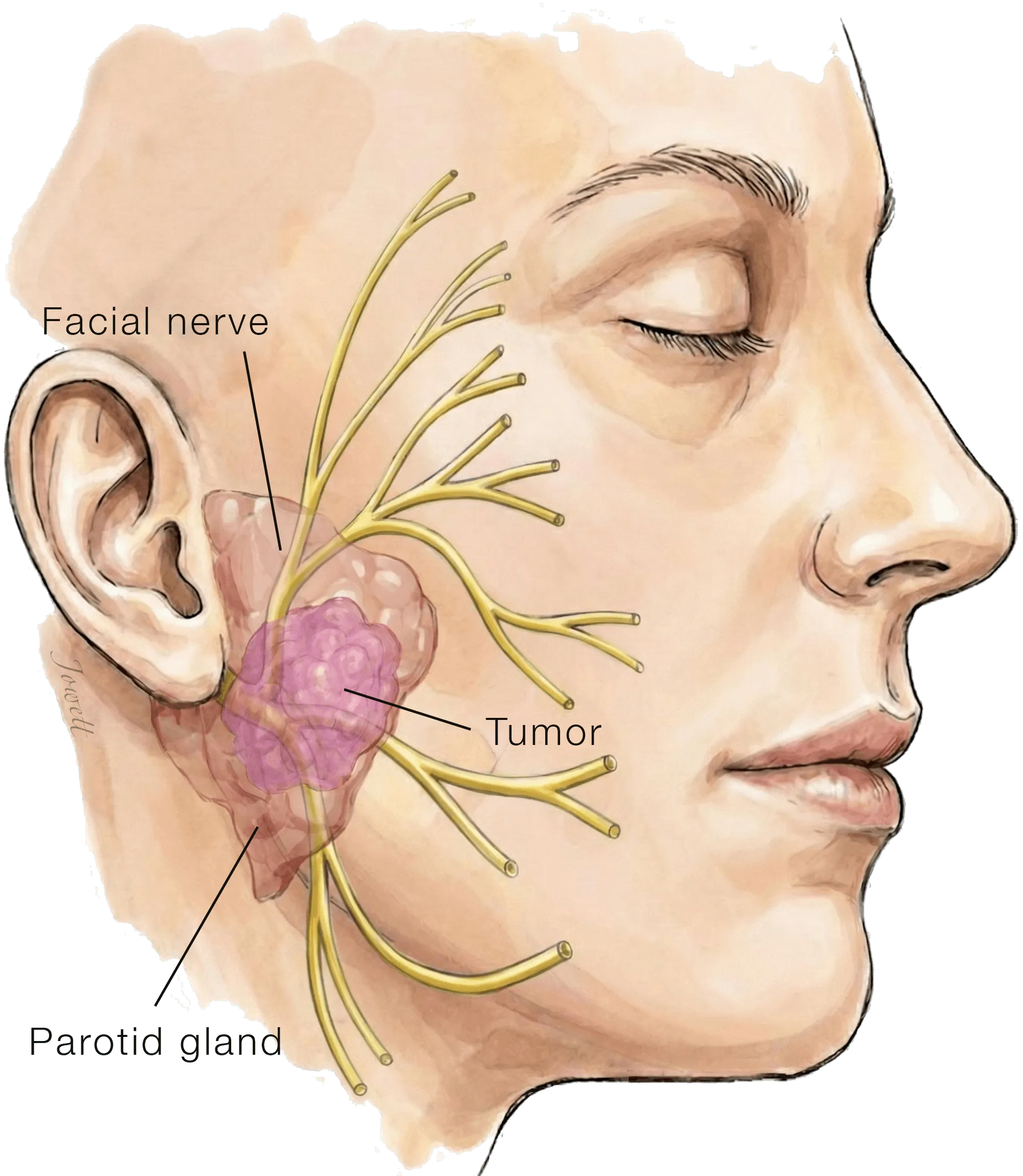
The parotid glands are the largest salivary glands, located just in front of and below your ears. Uniquely, the facial nerve (7th cranial nerve) exits the skull and runs directly through the center of the parotid gland, splitting into five main branches that control all of your facial expressions.
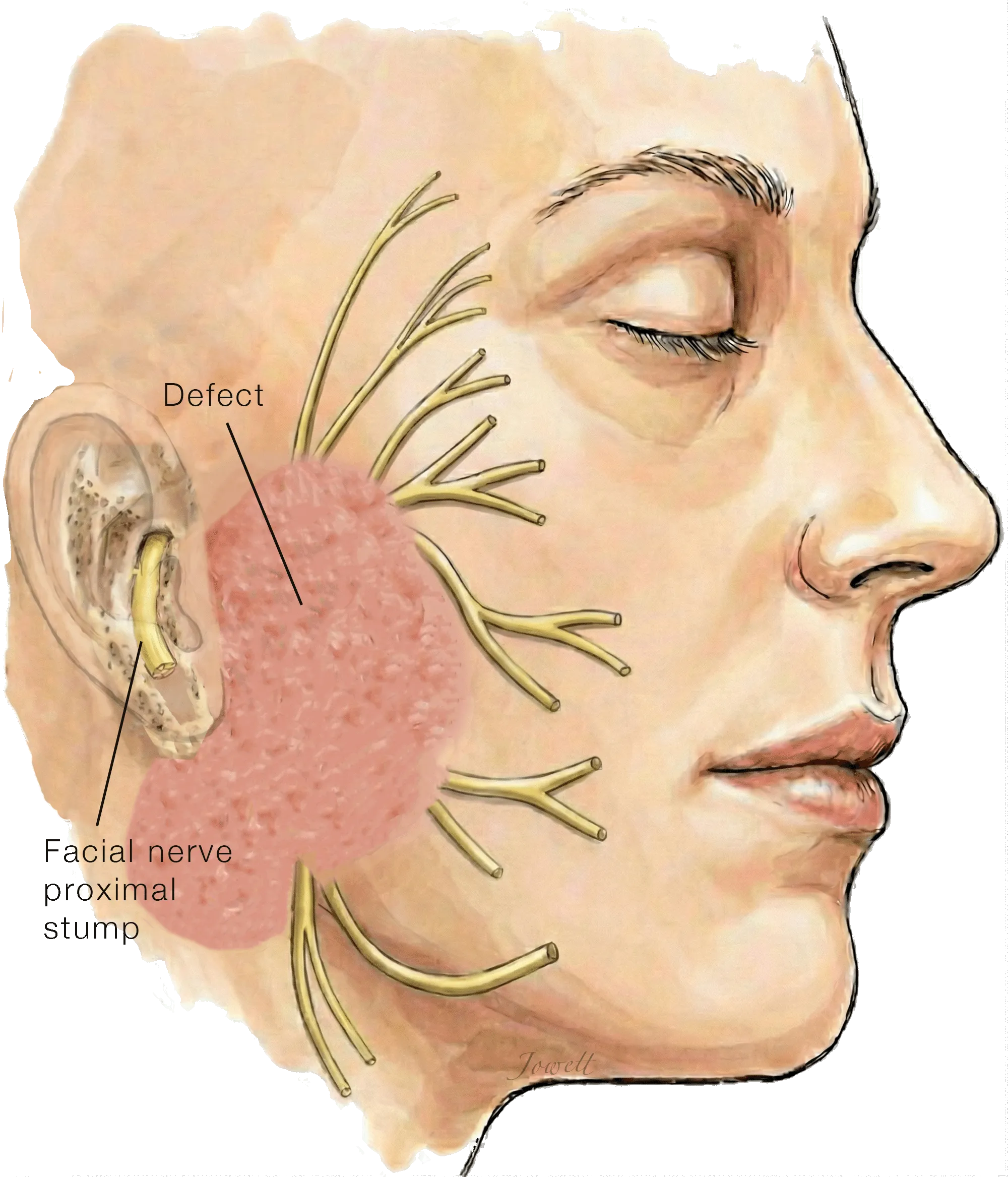
When a benign or malignant tumor develops in the parotid gland, it can surround, displace, or invade the facial nerve. During parotidectomy, cancer control takes priority. If an aggressive cancer involves the nerve, an oncologic surgeon may need to remove an affected segment to pursue an adequate resection; the margin plan and reconstructive options are individualized.
Like traumatic injuries, surgical sacrifice of the facial nerve results in immediate facial paralysis. Immediate reconstruction at the same operation is the standard of care. Planned radiation afterward should not delay that repair.
Same day
Best window to rebuild the nerve
4–6 mo
Typical smile return after masseteric transfer
RT OK
Radiation should not cancel reconstruction
Coordination is Key: Immediate Reconstruction
If you have been diagnosed with a parotid tumor and are scheduling a resection, it is highly recommended to consult with a facial reanimation specialist before your surgery.
Dr. Jowett can coordinate with head-and-neck oncologic surgeons when immediate reconstruction is appropriate. Repairing or grafting the nerve during tumor surgery can shorten denervation time and preserve reconstructive options, but recovery depends on the resection, nerve gap, muscle condition, radiation plan, age, and rehabilitation. Complete cancer treatment remains the first priority.
Parotid Tumor Nerve Involvement Symptoms
Symptoms can appear before surgery if the tumor is invading the nerve, or immediately after surgery if the nerve was manipulated or removed.
Pre-Surgical Weakness
If a parotid mass is accompanied by a gradually worsening facial droop or twitching before surgery, it is a strong indicator that the tumor is malignant and invading the nerve.
Post-Surgical Flaccid Paralysis
If the nerve is sacrificed, you will wake up with profound loss of muscle tone on that side of the face, causing a drooping mouth, flattened cheek, and difficulty speaking or eating.
Inability to Close the Eye
Like other forms of facial paralysis, the inability to blink or close the eye (lagophthalmos) is a medical emergency that requires immediate protective measures.
Parotid Tumor Reconstruction Options
Post-oncologic reconstruction often must account for missing tissue, large nerve gaps, and the effects of post-operative radiation therapy.
If a segment of the nerve is removed with the tumor, leaving a gap, Dr. Jowett harvests a sensory nerve — usually from the neck or leg — as a cable graft. Signals typically return over six to thirteen months. Delayed repair still helps if same-day reconstruction was not possible; it should not be abandoned.
What the Evidence Shows
When a parotid cancer takes the facial nerve, the best reconstruction is done the same day.
- Immediate cable grafting or nerve transfer restores tone better than leaving the face disconnected.
- Planned radiation should not delay repair. Studies show postoperative radiotherapy does not erase the benefit of a graft.
- When oncologically appropriate, the surgical plan aims to preserve a functioning nerve. Direct tumor involvement may require nerve removal and reconstruction.
- If no proximal stump remains, a masseteric-powered gracilis can still create a smile.
- New facial weakness alongside a parotid mass is uncommon and points toward a cancer rather than a benign growth. Weakness that comes on gradually, keeps worsening, or affects only part of the face should not be assumed to be Bell's palsy.
- The workup usually starts with ultrasound and an ultrasound-guided needle biopsy. Contrast MRI is preferred when nerve involvement or spread along nerves is a concern, with CT complementary for surgical planning.
- Weakness does not always mean the tumor has grown into the nerve. Whether a segment has to be removed is often confirmed during the operation itself.
- Removing a facial nerve that still works, purely to gain a wider margin, has not been shown to improve survival. Preservation is the aim whenever a plane can be developed between tumor and nerve.
- Recovery is gradual. Movement typically begins around four to six months after a nerve transfer and six to thirteen months after a cable graft, then continues to evolve over one to two years. Neuromuscular retraining is associated with better final function.
Why Choose Revitalis for Parotid Reconstruction?
Dr. Nate Jowett is a facial nerve surgeon whose clinical and peer-reviewed work includes facial reanimation. His fellowship training and background span facial plastic surgery, engineering, and reconstructive microsurgery.
Whether you are days into a diagnosis or have lived with incomplete recovery for years, Dr. Jowett offers the full spectrum of care, from medical management to cutting-edge surgical reconstruction, to help you regain your smile and confidence.
Common questions
Questions Patients Ask
Does every parotid tumor cause facial paralysis?
No. Many benign and malignant parotid tumors present with normal facial movement. New weakness increases concern and should prompt expedited evaluation, but it is not by itself a final diagnosis.
Can the facial nerve be reconstructed during cancer surgery?
Often, yes. When a segment must be removed, immediate grafting or a nerve transfer may shorten denervation time. The reconstructive plan must support—never compromise—complete tumor treatment.
What happens if radiation is also needed?
Radiation is coordinated with head-and-neck oncology. Available evidence suggests that postoperative radiation does not necessarily prevent meaningful recovery after nerve grafting, but wound, soft-tissue, and timing considerations are individualized.
What tests are done for a parotid lump that is causing facial weakness?
Evaluation usually begins with a head and neck examination that documents facial nerve function, an ultrasound, and an ultrasound-guided needle biopsy. Contrast MRI is preferred when nerve involvement or spread along nerves is a concern, with CT complementary for surgical planning, and staging scans added when cancer is confirmed.
Can facial weakness from a parotid tumor be mistaken for Bell's palsy?
It can, and that mistake costs time. Weakness that comes on gradually, keeps worsening, affects only part of the face, or fails to recover should not be assumed to be Bell's palsy, particularly with a history of skin or salivary gland cancer.
Will removing my facial nerve improve my chance of cure?
Not by itself. Removing a facial nerve that still works, purely to gain a wider margin, has not been shown to improve survival. The aim is to preserve a functioning nerve whenever a plane can be developed between tumor and nerve, with removal reserved for a nerve already paralyzed by tumor or directly invaded.
How soon after nerve reconstruction does movement return?
Recovery is gradual. Movement typically begins around four to six months after a nerve transfer and six to thirteen months after a cable graft, then continues to evolve over one to two years. Some weakness, asymmetry, or synkinesis commonly remains, and neuromuscular retraining is associated with better final function.
Answers are general and individualized at consultation.
Medical References & Evidence-Based Guidelines
- Free Gracilis Muscle Transfer for Smile Reanimation after Treatment for Advanced Parotid Malignancy. Faris C, Heiser A, Hadlock T, Jowett N. Head Neck. 2018 Mar; 40(3):561-568. PMID: 29155463.
- Postoperative Radiotherapy and Facial Nerve Outcomes Following Nerve Repair: A Systematic Review. Kenny HL, Jonas RH, Oyer SL. Otolaryngol Head Neck Surg. 2023;168(6):1338-1345. PMID: 36939391.
- Effect of Postoperative Brachytherapy and External Beam Radiotherapy on Functional Outcomes of Immediate Facial Nerve Repair After Radical Parotidectomy. Hontanilla B, Qiu SS, Marré D. Head Neck. 2014;36(2):244-249. PMID: 24375850.
- Quantitative Analysis of the Impact of Radiotherapy on Facial Nerve Repair With Sural Nerve Grafting After Parotid Gland Surgery. Yi CR, Oh TM, Jeong WS, Choi JW, Oh TS. J Craniomaxillofac Surg. 2020;48(7):692-698. PMID: 32527623.
- A General Approach to Facial Palsy. Jowett N. A General Approach to Facial Palsy. Otolaryngol Clin North Am. 2018 Dec; 51(6):1019-1031. PMID: 30119926.
- A Contemporary Approach to Facial Reanimation. Jowett N, Hadlock TA. JAMA Facial Plast Surg. 2015 Jul-Aug; 17(4):293-300. PMID: 26042960.
- Facial nerve reconstruction following parotidectomy for malignancy: A systematic review of microsurgical techniques and functional outcomes. Fernandez-Diaz OF, Retchkiman M, Garcia-Romero JM, et al. J Plast Reconstr Aesthet Surg. 2026;120:127-136. PMID: 42497567.
- Symptoms and signs of parotid tumors and their value for diagnosis and prognosis: a 20-year review at a single institution. Inaka Y, Kawata R, Haginomori SI, et al. Int J Clin Oncol. 2021;26(7):1170-1178. PMID: 33826026.
- Benign parotid mass and facial palsy: systematic review. Stewart KE, Bannon R, Bannister M. Ann R Coll Surg Engl. 2021;103(1):47-52. PMID: 32969265.
- Signs and symptoms of parotid gland carcinoma and their prognostic value. Stodulski D, Mikaszewski B, Stankiewicz C. Int J Oral Maxillofac Surg. 2012;41(7):801-6. PMID: 22542080.
- Impact of facial nerve resection in parotid cancer abutting the facial nerve without preoperative paralysis: A multicentric propensity score-based analysis. Chatelet F, Chevret S, Fakhry N, et al. Eur J Surg Oncol. 2025;51(8):108746. PMID: 39424524.
- Facial Nerve Graft in Malignant Tumors: The Role of Facial Rehabilitation. Mattioli F, Galloni C, Alberti C, et al. J Clin Med. 2025;14(3). PMID: 39941638.
- Adjuvant radiotherapy in node-negative salivary malignancies of the parotid gland: A multi-institutional analysis. Park JB, Wu HG, Kim JH, et al. Radiother Oncol. 2023;183:109554. PMID: 36813174.
- A Multi-Institutional Review of Characteristics of Idiopathic Versus Non-Idiopathic Facial Paralysis. Mandava S, Gossett K, Monaghan NP, et al. Laryngoscope. 2025;135(8):2882-2888. PMID: 40088138.