A General Approach to Facial Palsy
A Concise Guide to Treating Facial Palsy: From Diagnosis to Reanimation
What is this study about?
This comprehensive review outlines a modern framework for diagnosing and managing facial palsy (FP). It categorizes patients into five specific "management domains" based on the timing of their injury and the health of their facial nerve[93]. Rather than applying a single treatment to all patients, this paper serves as a roadmap for determining exactly when to use medication, physical therapy, or surgical reanimation to restore a smile.
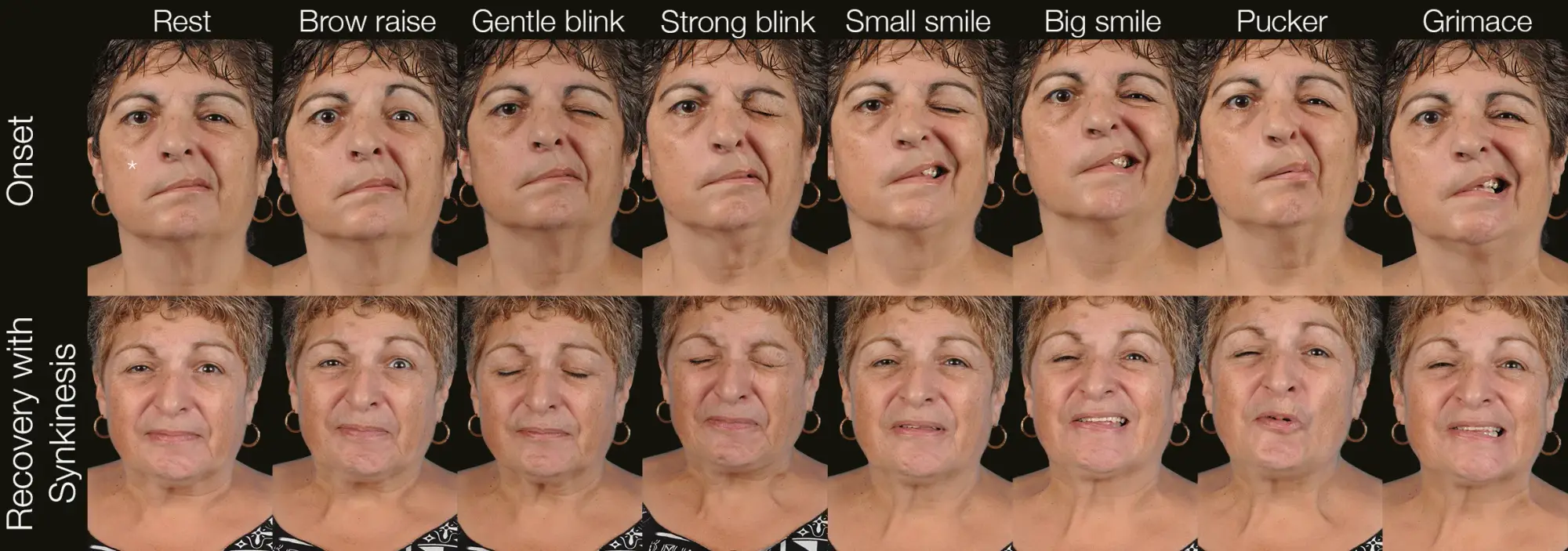
Key Findings for Patients
- Facial Palsy is a Spectrum: The condition ranges from flaccid paralysis (no movement) to post-paralytic syndrome, which includes tightness, spasms, and "synkinesis" (unwanted facial movements)[7, 14].
- The "5 Domains" of Treatment: The framework organizes patients into five management groups[93]:
- Acute Flaccid Palsy: The early period after onset. Care depends on the cause and may include diagnosis-specific medication plus eye protection[96, 99].
- Potential for Spontaneous Recovery: Patients with an intact nerve who are expected to recover within 6-12 months[112].
- Viable Muscle but Low Recovery Potential: Patients with nerve damage where the muscle is still alive during a time-limited interval. Nerve transfer may be considered here[213, 217].
- No Viable Muscle: Long-standing paralysis where the native smile muscle is no longer receptive to a new nerve signal. Muscle transfer, including a gracilis flap, may be considered[223, 228].
- Post-Paralytic Facial Palsy (Synkinesis): Chronic linked movement after nerve recovery. Options include neuromuscular retraining, chemodenervation, and selected surgery[231, 240].
- Timing is Critical: For nerve transfers to work, the native facial muscles must still be receptive to nerve signals. That interval varies with the injury and clinical findings[217].
- The Importance of Eye Care: Regardless of the stage, protecting the cornea matters whenever blink, eyelid closure, or corneal sensation is impaired[106, 111].
What this means for your treatment
This research establishes that "waiting and seeing" is not always the best approach. If you have acute Bell's palsy, oral corticosteroids started within 72 hours improve the chance of complete recovery[99]. However, if you have had paralysis for over a year, the paper highlights that the facial muscles may still be viable for nerve transfer procedures[217].
For patients with synkinesis (tightness and linked movement), the framework emphasizes neuromuscular retraining and targeted chemodenervation before selected surgical options[239, 240].
Common Questions Answered by this Research
How long do I have to get surgery?
If a facial nerve injury is known or strongly suspected to be divided, prompt specialist evaluation for repair or reconstruction is important[101]. Nerve transfer is time-sensitive because native facial muscles gradually lose the ability to respond after denervation[217]. When native smile muscle is no longer viable, regional or free functional muscle transfer may be considered[224].
Does physical therapy help?
It can. In the acute period, therapy may support education, movement monitoring, and strategies that complement eye care[107]. For chronic synkinesis, "neuromuscular retraining" is the first-line treatment[233, 239].
What if my face feels tight or twitches?
Tightness, twitching, or linked movements after recovery may represent post-paralytic synkinesis caused by aberrant nerve regeneration[14]. Treatment focuses on relaxing the hyperactive muscles[240].
Citation & Links
Citation: Jowett N. "A General Approach to Facial Palsy." Otolaryngologic Clinics of North America. 2018 Dec;51(6):1019-1031.
A clear next step
Discuss which treatment domain fits the current stage
The timeline, cause, nerve continuity, movement pattern, eye findings, and prior treatment are evaluated together. The published algorithm provides a framework; an individual examination determines the plan.