Men's Neck Lift in Scottsdale
A structural neck lift planned around male anatomy, with a shorter recovery than a full facelift usually asks for.
The neck is usually the first part of the face a man reads as tired or heavier than he feels. Revitalis performs structural neck lift surgery in Scottsdale for men across Greater Phoenix and for patients who travel here. This page covers what the operation changes, how it is planned around male anatomy, what recovery actually looks like, and what a neck lift will not fix.
Related case studies
Why men come in
Very few men book a consultation asking to look younger. They arrive with something specific and recent. A video call where the camera sits below eye level for an hour. A photograph somebody took from the side. A collar that measures the same as it always did but sits differently now. A jawline that used to be there.
It reads less like vanity and more like maintenance. Most of these men are still working, still training, still in front of people, and the neck has stopped matching the rest of it. That is a reasonable thing to want fixed and it is a reasonable thing to say out loud in a consultation.
Discretion is part of the goal, not a side note. The standard we plan to is simple: nobody should be able to tell what changed, only that you look rested. That standard drives the incision placement, how much skin is moved, and the direction it is moved in.
What is different about a male neck
A neck lift in a man is not the same operation performed on different skin. The anatomy changes the plan, and the plan changes where the incisions go and how far the tissue is moved.
Tissue
Thicker skin, richer blood supply
Male neck skin is thicker, more sebaceous, and carries a denser blood supply than female skin, and the platysma and the fat beneath it are usually heavier. Published male neck lift technique reflects that: the result depends more on reducing the deep layer than on pulling skin, thick skin redrapes less readily and is not closed under tension, and bleeding control gets more attention than it would in a thinner neck.
Beard
Beard-bearing skin has to stay where it belongs
Much of the skin being repositioned grows hair. Moving it carelessly puts beard skin behind the ear or into the sideburn, which is the classic tell. Incisions are planned against your beard line and sideburn, and against how short you actually wear your hair, because a fade leaves far less cover than hair over the ears.
Structure
A stronger jaw is an asset, not an obstacle
A heavier mandible gives the repair something to work against, so the target is a cleaner angle under an existing jaw rather than the creation of a new one. What the operation can reach also depends on the deeper anatomy, including subplatysmal fat and the position of the submandibular glands.
Vectors
No feminising vectors
The direction the tissue is lifted is a deliberate choice. Vectors that narrow the lower face and lift the cheek high are appropriate for some patients and wrong for most men. The plan here keeps a square jaw square and treats the angle under it as the thing to define.
Neck lift without a facelift
A neck lift and a facelift are separate operations that are often combined. A facelift repositions facial soft tissue, including the jowls. A neck lift addresses the platysma, the submental tissue, and the neck skin. If your face does not bother you, there is no requirement to treat it.
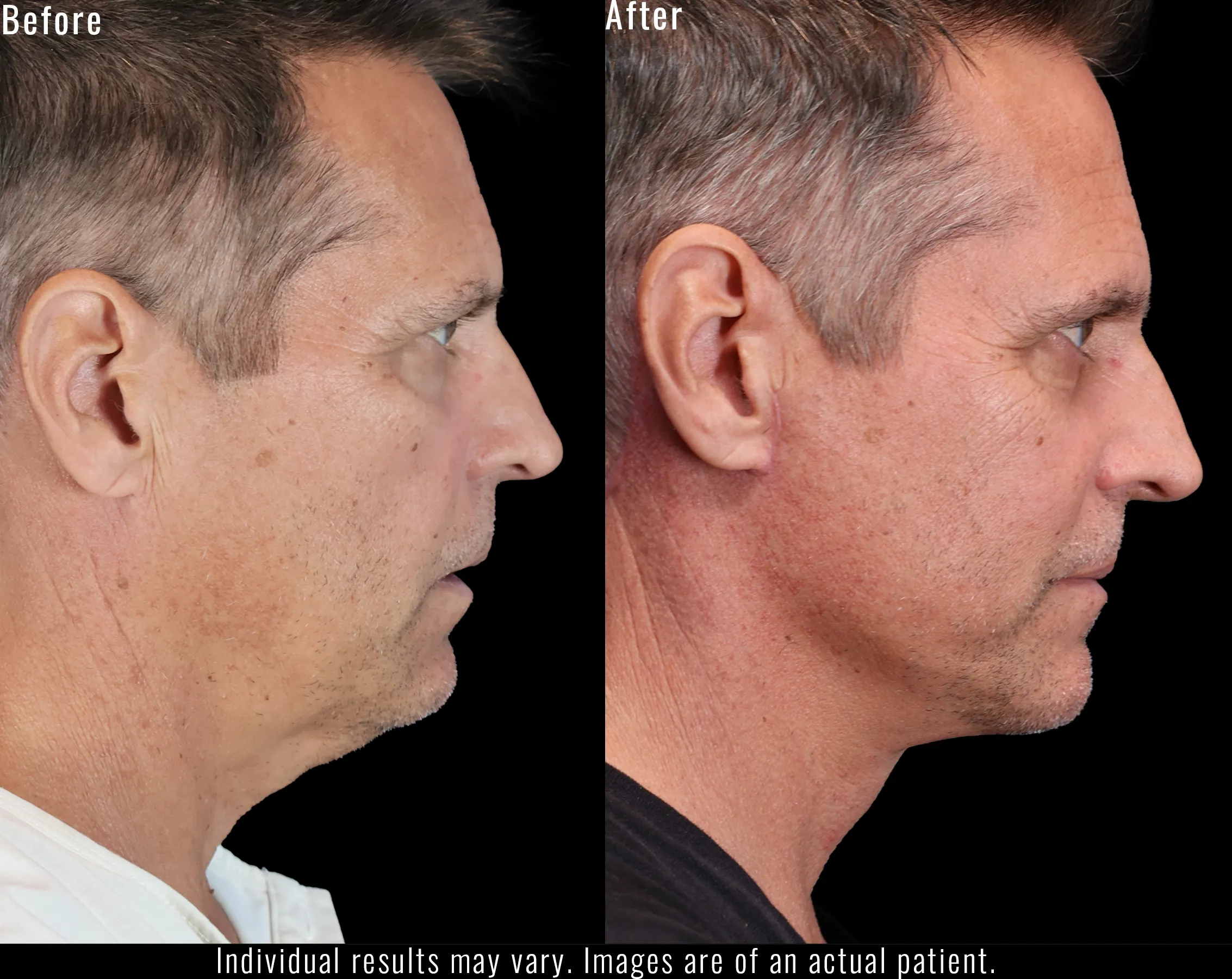
The case published on this page is exactly that operation. A 61-year-old man presented with submental fullness, separation of the midline platysma, and loss of definition at the jaw and cervicomental angle. The plan was a deep structural platysmaplasty with submental contouring and no facelift: the platysma edges were brought together in the midline and the muscle and skin were resuspended. See the full six-month record on the structural neck lift case page.
These numbers describe one patient's course. They are not a schedule, a promise, or an average. Your own operating time, anesthesia plan, and recovery depend on your anatomy, how much the neck needs, and how you heal.
One patient, one operation
- Patient61-year-old male
- Operative duration3 hours
- AnesthesiaLocal or sedation
- Self-care recoveryImmediate
- Social recovery7 to 10 days
- Facelift performedNone
Downtime, honestly
Recovery is staged rather than instant, and the parts that last longest are the ones nobody warns you about: tightness under the chin and numbness along the jaw. The stages below are what is typically planned for. They are not a schedule you are held to, and your surgeon's instructions override anything on this page.
Day 1
You are up and caring for yourself. A dressing or support garment is usually worn. Blood pressure is watched closely, because this is the window in which bleeding matters most.
Week 1
Swelling and bruising are usually at their most noticeable. Sutures come out on a set schedule. Light walking is generally fine; anything that spikes blood pressure is not. Most men are not on camera yet, and the published series put a return to desk work at roughly one to two weeks.
Week 2
This is where most men aim to be presentable again. Residual swelling and tightness are common and are not the result. Shaving over the incisions is discussed rather than assumed.
Month 1
Exercise is staged back in rather than cleared all at once: light aerobic work at around two to three weeks, heavy lifting and hard training closer to four to six weeks, once the tissue has adhered and the bleeding window has passed. The neck contour is readable but still settling, and numbness along the jaw and under the chin often persists.
Month 6
This is the point at which the case photographs on this page were taken, and a reasonable point to judge contour and scars. Both continue to mature past it; formal outcome studies grade neck lift results at twelve months or later. Aging continues regardless of the operation.
The bleeding risk deserves a direct answer
Hematoma, a collection of blood under the skin, is the most common early complication after facelift and neck lift surgery, reported in roughly one to three percent of patients in large databases. Men have historically carried a several-fold higher risk, attributed to thicker skin, a richer blood supply, and higher baseline blood pressure. The most useful finding in the recent literature is that the gap is largely modifiable: a matched cohort published in 2026 found no male excess once strict blood-pressure control and local tranexamic acid were standard, and series that hold systolic pressure below 140 or 120 after surgery report hematoma rates well under one percent.
That is why blood-pressure control is planned before you go home, why anticoagulants, antiplatelet drugs, and several supplements are reviewed on an individual schedule, why nausea and coughing are treated rather than tolerated, and why straining and heavy lifting are held back early.
Rapidly increasing swelling on one side, severe pain, or bleeding should be reported immediately rather than waited out. A tense expanding hematoma may need urgent treatment. Other recognized risks include infection, delayed skin healing, unfavorable scars, contour irregularity, numbness, hairline or ear changes, nerve weakness, anesthesia complications, asymmetry, and the possibility of revision.
What it will not do
A neck lift repositions structure. It does not change skin quality, sun damage, fine lines, or pigment, and it is not a substitute for losing weight. It does not treat the face, so jowling and midface descent are a separate conversation. Deep fat and submandibular gland fullness are addressed only to the extent the plan allows and the anatomy safely permits. It does not stop aging.
Alternatives worth weighing
- Liposuction alone. Removing submental fat can help a neck with good skin tone and an intact platysma. It does nothing for banding or laxity, and in the wrong neck it makes the underlying separation more visible.
- Injectables. Neuromodulators can soften platysmal bands and fat-dissolving injections can reduce a small submental pocket. Neither repositions muscle or skin, and both are repeat treatments.
- Resurfacing. If the real complaint is texture, crepe, or sun damage rather than contour, resurfacing addresses that directly. It has its own candidacy, downtime, and risks. See skin resurfacing.
- A full facelift. If the jowl is doing more of the work than the neck, treating the neck alone will disappoint you. See deep plane facelift and neck lift.
- No procedure. A consultation that concludes surgery is not worth it for you is a useful consultation.
Before and after
One published male case: a primary structural neck lift with deep platysmaplasty and no facelift, photographed at six months from five angles. The full record, including planning and outcome notes, is on the structural neck lift case page.
Primary Structural Neck Lift
Deep Platysmaplasty & Submental Contouring
This case highlights a primary structural neck lift without facelift for a male patient seeking improvement in his lateral neck profile and cervicomental angle. He presented with submental fullness, separation of the midline platysma, and loss of cervical contour. Dr. Jowett performed a deep structural platysmaplasty under sedation, bringing the platysma together in the midline and resuspending the skin and muscle.
None
None
Surgical Fact Sheet
- Patient Demographics61-year-old Male
- Operative Duration3 Hours
- Anesthesia AdministeredLocal or Sedation
- Self-care recovery windowImmediate
- Social Recovery Window7 - 10 Days
Right lateral
Reduced submental fullness with improved jaw and neck contour
Individual results vary. These photographs show specific patients at the stated follow-up interval and do not predict another patient’s outcome. Procedure, anatomy, healing, and photography conditions differ by case.
Facial plastic, reconstructive, and facial nerve expertise
Dr. Nate Jowett is a Harvard-trained facial plastic and reconstructive surgeon whose practice includes facial reconstruction, facial reanimation, and nerve surgery alongside facelift and neck lift work. Neck lift surgery is performed in planes that carry the marginal mandibular and cervical branches of the facial nerve, and detailed familiarity with those branches is the reason the deeper work is approached the way it is. Every neck lift still carries recognized risks, and consultation reviews them alongside the proposed plan and the alternatives.
Facial plastics
Board certified by the American Board of Facial Plastic and Reconstructive Surgery.
Head and neck surgery
FRCSC and certified in Otolaryngology – Head and Neck Surgery; verify in the Royal College directory.
Harvard training
Fellowship-trained in facial plastic surgery at Harvard Medical School and a former Harvard faculty member. Review his Harvard Catalyst profile.
Anatomy-conscious risk planning
Individual risk is assessed from medical history, medications, prior procedures, anatomy, skin quality, and nicotine exposure rather than from the name of a technique. That assessment is what determines whether an operation is offered and how it is planned.
What the Evidence Shows
A neck lift is a structural operation performed near facial nerve branches, so anatomy, technique, and patient-specific risk assessment matter more than the label on the procedure. Most of the neck lift literature is single-surgeon or retrospective series in which men are a minority, so the male-specific points below rest on technique papers and a small number of dedicated male cohorts.
- The dedicated male neck lift literature describes thicker, more sebaceous, beard-bearing skin with a richer blood supply, a bulkier platysma with heavier deep fat, and a target angle under the chin that is deliberately less sculpted than a female neck; results are attributed more to deep reduction than to skin tension.
- Incision planning in men is constrained by the beard and sideburn: hair-bearing skin must not be carried behind the ear or into the sideburn, and incisions within beard skin are placed to spare follicles.
- Hematoma is the most common early complication of facelift and neck lift surgery, around one to three percent overall; in an 11,300-patient database, male sex carried close to four times the risk, and elevated blood pressure before, during, and after surgery predicts it independently.
- The male hematoma gap appears modifiable: a 2026 matched cohort using strict blood-pressure control and local tranexamic acid found no male excess, and protocols holding systolic pressure below 140 or 120 mmHg after surgery report rates below one percent.
- Isolated neck lift with platysmaplasty, performed without a facelift, produces measurable improvement in the angle under the chin and high satisfaction in published series, with follow-up documented to about two years; those series are single-arm, and no study compares its long-term durability head to head with a combined facelift and neck lift.
- Reported recovery is staged: return to desk work at roughly one to two weeks, light exercise at two to three weeks, strenuous training at four to six weeks, with final contour judged at six to twelve months and formal outcomes measured at a year or later. These figures come from case series, not controlled trials.
- Men in the published series report high satisfaction, and the dedicated male reports name workplace vitality and a short recovery as the main motivations; validated outcome studies find no difference in satisfaction by sex, although few analyses separate men as a group.
- Deep neck work on the subplatysmal fat, digastric muscles, or submandibular glands is added only when fullness persists after the skin, fat, and platysma are addressed; a systematic review of deep plane neck lifting reports high satisfaction but a higher rate of temporary nerve weakness than a conventional neck lift, with gland reduction carrying the most risk.
Men's Neck Lift Consultation
The consultation looks at your neck, your jaw, your beard pattern, and your skin, and separates what a neck lift can change from what it cannot. It covers whether treating the neck alone will give you what you are describing, whether the face needs to be part of the plan, the anesthesia options, the recovery you should budget for, and the risks.
No specific result or recovery timeline is promised. Dr. Nate Jowett reviews the alternatives, including doing nothing, before a surgical plan is chosen.
Scottsdale practice serving Greater Phoenix
Plan a private face and neck consultation
Revitalis welcomes patients from Scottsdale, Phoenix, and communities across the Valley, as well as patients traveling from elsewhere in the United States and internationally. Consultation is used to evaluate anatomy, goals, prior procedures, alternatives, recovery, and risk before a plan is chosen.
Revitalis
7600 E Camelback Rd, Ste 7
Scottsdale, AZ 85251
Common questions
Men's neck lift FAQs
How long is recovery after a neck lift for a man?
Most men plan on a week to ten days before they are comfortable in a meeting or on camera, and the case shown on this page had a seven to ten day social recovery. Swelling, tightness, and numbness under the chin last longer than the bruising does, and the final neck contour keeps settling for months. Your own timeline depends on how much work the neck needs, how you heal, and what you do for a living.
Will the incisions show if I have a beard or short hair?
Incision placement is planned against your beard line, sideburn, and how short you wear your hair, because a man with a fade has far less cover than someone with hair over the ears. The incisions sit under the chin and around the ear. They are planned to sit in natural creases and hair-bearing edges, but a scar is still a scar, and visibility depends on placement, healing, and skin type rather than on technique alone.
Will it look done?
The goal is that nobody can name what changed. A neck lift repositions the platysma and the neck skin; it is not meant to change the shape of your face or the way you look in conversation. Lifting vectors are chosen to keep a masculine jaw and neck line rather than to soften it. Overcorrection is the failure mode being planned against, and that plan is discussed before surgery rather than after.
Can this be done under local anesthesia instead of general?
Sometimes. The case shown on this page was performed under local anesthesia or sedation over about three hours. What is appropriate for you depends on how much work the neck needs, your health history, airway and medication considerations, and your own preference. The anesthesia plan is decided in consultation with the anesthesia team, not chosen from a menu in advance.
Can I have a neck lift without a facelift?
Yes, and it is a common request from men whose neck bothers them while their face does not. A neck lift addresses the platysma, the submental tissue, and the neck skin; a facelift repositions facial soft tissue including the jowls. They are frequently combined, but they are separate operations. Consultation looks at whether treating the neck alone will give you the jawline you are describing, or whether the jowl is doing more of the work than you think.
Is the risk of a hematoma higher in men?
Historically, yes. Hematoma is the most common early complication after facelift and neck lift surgery, around one to three percent of patients overall, and large databases have reported several times that risk in men, attributed to thicker skin, a richer blood supply, and higher blood pressure. More recent series show the gap closes when systolic blood pressure is held down after surgery and local tranexamic acid is used. Blood-pressure control, careful hemostasis, and a review of anticoagulants, antiplatelet drugs, and supplements are part of the plan for that reason.
When can I lift weights or run again?
Light walking usually starts within days. Anything that raises blood pressure sharply, including heavy lifting, straining, and hard cardio, is held back longer because of the bleeding and swelling risk in the early period. Published guidance, which comes from case series rather than trials, is light aerobic exercise at around two to three weeks and strenuous training or resistance work at four to six weeks. Ask for your specific dates at your preoperative visit instead of working from a general number.
What will a neck lift not fix?
It will not change skin quality, sun damage, fine lines, or pigment, and it is not a substitute for weight loss. It does not treat the face, so jowling and midface descent need a separate conversation. Submandibular gland fullness and deep fat are addressed only to the extent the plan allows and the anatomy safely permits. Resurfacing, injectables, and doing nothing are all reasonable alternatives depending on what actually bothers you.
Answers are general and individualized at consultation.
Medical References & Evidence-Based Guidelines
- Neck Contouring and Rejuvenation in Male Patients Through Dual-Plane Reduction Neck Lift. Bravo FG. Clin Plast Surg. 2022;49(2):257-273. PMID: 35367033.
- The Modern Male Rhytidectomy: Lessons Learned. Rohrich RJ, Stuzin JM, Ramanadham S, et al. Plast Reconstr Surg. 2017;139(2):295-307. PMID: 28125532.
- Male Face-Lift Finesse. Rohrich RJ, Novak M. Plast Reconstr Surg. 2023;151(2):241e-244e. PMID: 36696315.
- Rejuvenation in Men Facial Aging: A Combined Approach. Klinger M, Fondrini R, Bandi V, et al. Aesthetic Plast Surg. 2024;48(8):1522-1528. PMID: 38286900.
- Preoperative Risk Factors and Complication Rates in Facelift: Analysis of 11,300 Patients. Gupta V, Winocour J, Shi H, et al. Aesthet Surg J. 2016;36(1):1-13. PMID: 26578747.
- Revisiting Hematoma Rates In Male Patients After Facelift Surgery: A Matched Cohort Analysis. Vishwanath N, Darras O, Mandelbaum M, et al. Plast Reconstr Surg. 2026. PMID: 42154486.
- Systolic Blood Pressure Less Than 120 mmHg is a Safe and Effective Method to Minimize Bleeding After Facelift Surgery: A Review of 502 Consecutive Cases. Bassiri-Tehrani B, Abi-Rafeh J, Baker NF, et al. Aesthet Surg J. 2023;43(12):1420-1428. PMID: 37439229.
- Evolution of hypertension management in face lifting in 1089 patients: optimizing safety and outcomes. Ramanadham SR, Mapula S, Costa C, et al. Plast Reconstr Surg. 2015;135(4):1037-1043. PMID: 25811571.
- The "anterior-only" approach to neck rejuvenation: an alternative to face lift surgery. Zins JE, Fardo D. Plast Reconstr Surg. 2005;115(6):1761-8. PMID: 15861088.
- Anterior Approach to the Neck: Long-Term Follow-Up. Kochuba AL, Surek CC, Ordenana C, et al. Aesthet Surg J. 2021;41(8):861-870. PMID: 32436583.
- Fixation of Superolateral Platysma Flap to the Mastoid Fascia: A Novel Isolated Neck Lift Technique. Okumus A. Aesthetic Plast Surg. 2024;48(22):4619-4630. PMID: 39266681.
- Secondary Neck Lift and the Importance of Midline Platysmaplasty: Review of 101 Cases. Narasimhan K, Ramanadham S, O'Reilly E, et al. Plast Reconstr Surg. 2016;137(4):667e-675e. PMID: 27018694.
- Current Trends in Deep Plane Neck Lifting: A Systematic Review. Chinta SR, Brydges HT, Laspro M, et al. Ann Plast Surg. 2025;94(2):222-228. PMID: 39652837.
- Adverse Events Related to Submental Aesthetic Liposuction: A Systematic Review. Girão YRG, Soares AC, Costa FWG, et al. J Oral Maxillofac Surg. 2026. PMID: 42235595.
- Outcome analysis in 93 facial rejuvenation patients treated with a deep-plane face lift. Swanson E. Plast Reconstr Surg. 2011;127(2):823-834. PMID: 20966814.
- Facial Aging Surgery: Healing Time, Duration Over the Years, and the Right Time to Perform a Facelift. Botti C, Botti G, Pascali M. Aesthet Surg J. 2021;41(11):NP1408-NP1420. PMID: 34337655.
- Facelift Surgery and Nerve Injury: A Systematic Review and Meta-Analysis. Gandra G, Silva BS, Horta R. Aesthetic Plast Surg. 2025;49:5696-5711. PMID: 40456989.